Health & heat
Back-safe living: furnish the house, spare the spine
Ramps, rugs, one correct lift and a short red list of games: the cheap household policy that lets a long-backed comedian stay airborne-free and injury-free.
Nelson and Kim, Curious Tails · AVS licence AS24J00046
How do I protect my corgi’s back?
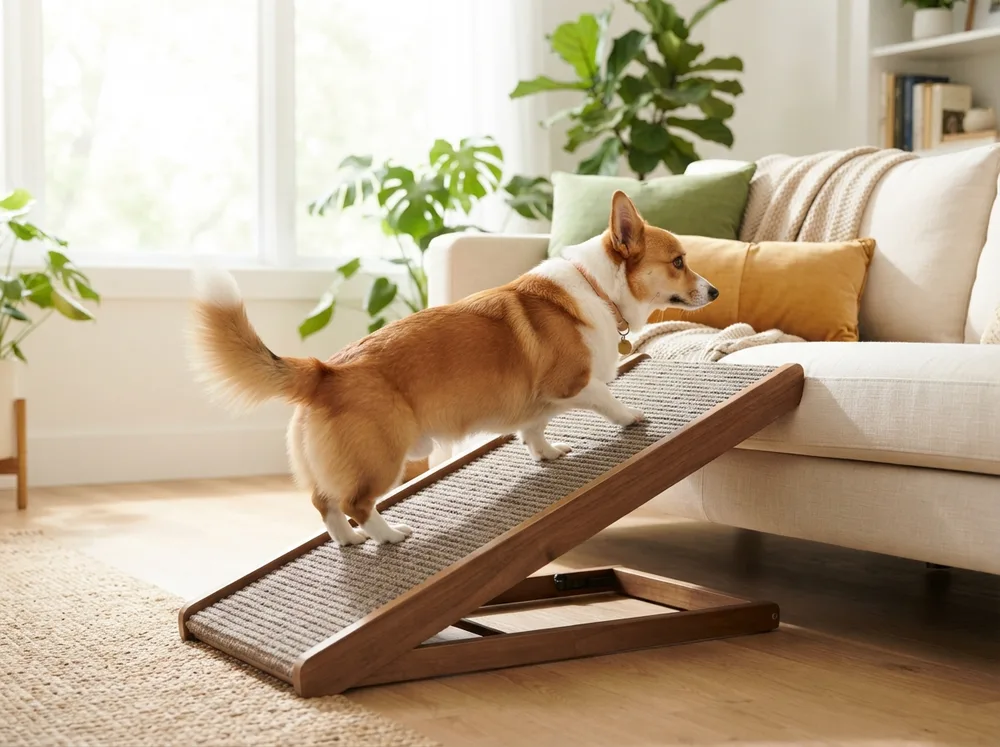
Redesign the environment once: ramps at sofa and bed, Y-harness on every walk, rugs on slippery tile, gates on stairs, short nails, lean weight, and the two-point level-spine lift (kids never carry the dog). Green-light flat games and swimming; red-light anything airborne. Sudden wobble, hunching or jump-refusal = vet today.
Why a corgi home gets furnished differently
The corgi's silhouette is a physics problem wearing a grin: a long spine suspended between short legs, which concentrates the forces of every jump, twist and skid at the discs between the vertebrae. The breed carries documented intervertebral disc disease (IVDD) risk, real, though at meaningfully lower reported rates than its dachshund cousin at the extreme end of the table, and the honest response is neither fear nor fatalism but furniture policy: a set of cheap, one-time household decisions that delete the highest-load events from the dog's daily life before they ever total up.
Our health guide covers the medicine; this page is the practical sequel, the room-by-room setup we describe to every buyer, ideally installed before the puppy's first zoomie.
The mindset shift that makes it stick: back safety is not a restriction on the dog, it is a redesign of the environment. A back-safe corgi still sprints, plays, swims and lives at full corgi intensity, horizontal athleticism is unlimited, remember, it simply stops paying a vertical tax it never needed to pay.
Households that frame it as "the house works differently" succeed; households that frame it as "the dog is fragile" quit the system within a season, because the dog visibly is not fragile, right up until the day the odds catch up.
The back-safe kit
- Ramp or step stool: sofa and bed
- Y-harness for every walk, no collars
- Rugs or runners on slippery tile
- Baby gate at any staircase
- Nails kept short (gait = spine)
- Lean weight: the multiplier control
Room by room: the Singapore setup
Living room. The sofa is the crime scene of corgi back injuries, not the ascent, the fifty-times-a-day flying dismount onto tile. Install a ramp or broad step stool at the dog's preferred corner, train it in a week (treats up, treats down, block the shortcut with a cushion until the habit sets), and the sofa becomes legal territory at a legal price. If the dog is a dedicated launcher, a firm "off" cue plus consistent redirection beats negotiation.
Bedroom. Same logic, taller stakes: beds are higher than sofas, and night-time dismounts onto dark floors are the worst-case jump. Ramp, or a policy that the bed is invitation-and-lift only.
Floors generally. Singapore's tile and marble are beautiful and frictionless; a scrabbling, cornering corgi on polished tile is loading its spine through every skid. Rugs and runners along the dog's main racing lines, hallway, sofa approach, feeding station, convert the circuit to grip, and short nails (clicking means overdue) keep the gait clean on whatever remains.
Stairs and lifts. A landed home's staircase gets a baby gate; occasional supervised flights are fine, unsupervised staircase sprints are not, and in condo life the lift simply wins over the stairwell, every time, forever.
The car. Lifted in, lifted out, or a boot ramp; the leap from a boot lip onto a car park floor is sofa-dismount physics with extra height. None of this costs more than a few hundred dollars total, most of it once, and all of it is cheaper than a single night at the emergency vet, before we even reach the surgical numbers.
Horizontal athleticism unlimited, vertical athleticism rationed, and the house does the enforcement so you never have to.
Hands and habits: lifting, kids, games
Lifting technique matters more for this shape than almost any breed, and most people do it wrong by instinct: hoisting under the front legs leaves half a metre of unsupported spine hanging like a drawbridge. The correct lift is two points, level spine: one arm under the chest behind the front legs, the other under the hindquarters, dog held against your body, back horizontal throughout, lowered feet-first, never dropped.
Teach every household member, and give children the simpler rule: kids do not carry the corgi, full stop. A wriggling ten-kilogram dog exceeds a child's safe handling by miles, and the family policy ("we pat the corgi on the floor, where it lives") prevents the accident nobody could have reacted to.
This slots into the same family-roster conversation as our nips guide: the dog thrives on rules everyone runs identically.
Games get sorted by trajectory. Green list: flat fetch with low rolling throws, flirt-pole circles kept at ground level, tug with four paws planted, scent games, digging boxes, and swimming, the perfect corgi sport, full cardio at zero spinal load, and most corgis take to it with a vest and a shallow start.
Amber: brief low jumps on grass in play, unavoidable and survivable, just not the game's centrepiece. Red list: frisbee leaps, jump-catch treats, agility bar work, staircase sprints, and the beloved-but-terrible "jump up for the toy" tease. The dog will not audit its own list, that is the household's job, and visiting relatives with a tennis ball are the usual leak.
The signs that outrank everything on this page
Prevention lowers odds; it cannot zero them, so every corgi household memorises the emergency card. Same-day vet signs: sudden reluctance to jump, climb or do stairs; a hunched, rigid back or tucked tense belly; yelping when touched, lifted or moving; hind-leg wobble, crossing steps, toes knuckling or dragging; sudden incontinence with any of the above.
Emergency-now signs: hind-end collapse or paralysis, dragging both legs, in which case crate-rest the dog immediately, carry with the level-spine lift onto a rigid surface, and go, because with disc emergencies the treatment window is measured in hours and outcomes track speed of care. Do not wait-and-see a wobble, do not massage it, do not "walk it off". The care line hears one of these stories a year, and the families who moved fast are the ones whose stories end well.
Two closing pieces of adult arithmetic. Insurance: disc surgery in Singapore runs into five figures, IVDD is exactly the kind of breed-associated condition worth reading a policy's fine print for, and cover bought young, before anything is "pre-existing", is the version that pays.
And timing: the whole system on this page works best installed from week nine, when the puppy's habits are wet cement, ramps learned as furniture, harness as clothing, floor as the patting zone, lean as the lifestyle. Retrofit it for an adult corgi anyway; spines do not care when the good habits started, only that they did.
The reward for all this quiet policy is the best kind of anticlimax: a long-backed comedian that sprints, swims and herds its family for twelve-plus years, and never once finds out what the ramp was really for.
Keep exploring
Frequently asked questions
Do corgis really get back problems?
The breed carries documented IVDD risk from its long-low build, lower than the dachshund’s but real. The response is household policy: ramps, Y-harness, grippy floors, lean weight and a no-launch culture, installed from puppyhood.
Do corgis need ramps?
For sofa and bed height, yes, or a trained step stool. The repeated flying dismount onto tile is the single highest-load daily event in a pet corgi’s life, and the ramp deletes it for under a hundred dollars.
How do I lift a corgi correctly?
Two points, level spine: one arm under the chest behind the front legs, one under the hindquarters, dog against your body, lowered feet-first. Never hoist under the armpits, and children never carry the dog at all.
Are stairs forbidden?
Occasional supervised flights are fine; daily staircase sprints are not. Gate staircases, take the lift in condo life, and let the ration do its quiet work.
Which games are back-safe?
Flat fetch, ground-level flirt pole, planted tug, scent work and swimming, the perfect zero-load corgi sport. Skip frisbee leaps, jump-catches and anything with the dog airborne as the point.
What are the emergency signs?
Sudden jump-refusal, hunched rigid posture, yelping at touch, hind-leg wobble or toe-dragging: vet the same day. Hind-end collapse or dragging: emergency now, level-spine carry, hours matter.
Is insurance worth it for the back?
Disc surgery runs to five figures here, so a policy covering IVDD, bought young before anything is pre-existing, is precisely the fine print worth reading. Pair it with the free prevention on this page.
Meet your Corgi
Come say hello at Balestier
2 Balestier Road #01-701, Singapore 320002 · Weekdays 12pm–6pm · Weekends 10am–6pm. Or message us first: tell us about your home and routine, and we'll tell you honestly if a Corgi fits.
Still deciding?
Read the price guide first: every dollar explained, no surprises at the shop.
See the price guide