Wardrobe, honestly
Corgi colours: the real palette, and the lines we will not cross
Red, sable, fawn and two tricolours over white: the whole legitimate Pembroke wardrobe, plus the black corgi truth, the fluffy reality, and the merle we refuse to sell.
Nelson and Kim, Curious Tails · AVS licence AS24J00046
What colours do corgis come in?
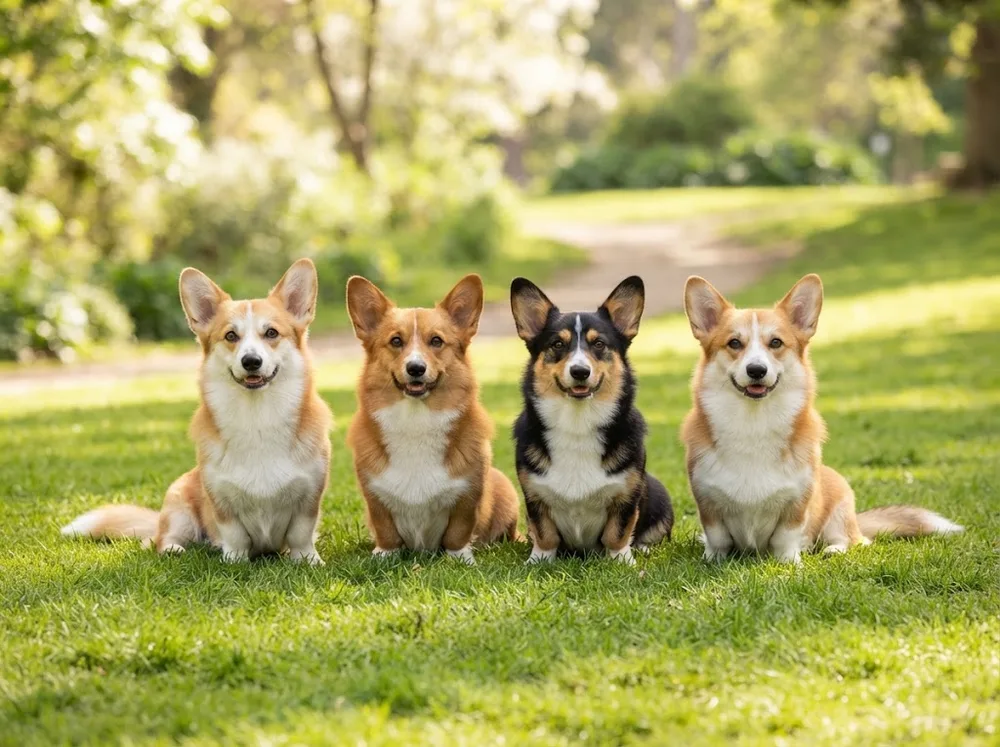
Pembrokes come in red, sable, fawn and tricolour (red-headed or black-headed), always with white markings, plus the long-coated fluffy variant of each. A mostly-black corgi is a black-headed tri; solid black and merle are not Pembroke colours, and merle signals crossbreeding with double-merle health risks. We price every colour identically.
The real Pembroke palette
The Pembroke Welsh Corgi comes in a short, honest list of colours, all worn over white markings: red, the classic orange-gold the world pictures; sable, red with black-tipped hairs that shade the shoulders and skull; fawn, the paler, creamier end of red; and tricolour, black, white and tan, in two flavours named for the head.
The red-headed tri keeps a red face over a black body; the black-headed tri carries black up the skull and around the eyes, the dramatic bandit look. White typically covers the muzzle blaze, chest, legs and belly, and none of these patterns has any connection to temperament, health or quality. Colour is wardrobe.
Puppy buyers should know two harmless surprises. First, coat change: corgi puppies often darken or clarify substantially as the adult coat comes in, sables can lighten, reds deepen, tri tan points spread, so choose the puppy, not the exact shade of the eight-week photograph.
Second, the fairy saddle: many reds and sables grow a subtle darker patch behind the shoulders where, Welsh legend insists, fairies once rode the breed into battle. It is folklore, it is free, and it is the best answer in dog-park small talk.
Pembroke colours, complete
- Red and white: the classic
- Sable: black-shaded red
- Fawn: the pale end of red
- Red-headed tricolour
- Black-headed tricolour
- All over white markings
- NOT Pembroke: merle, solid black, blue
The black corgi question, answered properly
"Black corgi" out-searches most colour queries, so here is the precise truth. A corgi that reads as mostly black is a black-headed tricolour, black body, tan points, white markings, and it is completely standard, healthy and handsome.
What does not exist in the purebred Pembroke is a solid black dog with no tan or white at all: the breed does not carry that combination, so an all-black "Pembroke" in an advert means either a mislabelled photo, a different breed, or crossbreeding somewhere recent.
The same logic covers "blue" (grey-diluted) corgis: dilution is not part of the Pembroke palette, and in some breeds it travels with a coat-health condition called colour-dilution alopecia besides. Our advice costs one sentence: if a corgi colour does not appear in the kennel-club standard, treat the advert as a question mark over the whole litter, whatever the paperwork claims about parentage.
If the colour is not in the breed standard, the question is not the colour. It is everything else about the litter.
Merle: the colour we refuse, and why
Merle, the marbled, patchwork coat, sometimes with blue eyes, belongs to the Cardigan Welsh Corgi and to breeds like the Australian Shepherd. It does not naturally occur in the Pembroke.
When a "merle Pembroke" appears for sale, the gene had to arrive from outside the breed, which means crossbreeding in the recent family tree, and the striking coat is functioning as a price sticker on a question mark.
The deeper problem is what happens when two merles meet. A puppy inheriting the merle gene from both parents, a double merle, carries a well-documented risk of congenital deafness and serious eye malformations, up to and including missing eyes. Ethical breeders of legitimately-merle breeds never pair merle with merle; volume sellers chasing a viral coat sometimes do, and the resulting puppies pay for it their whole lives.
Our shop's policy removes every layer of the problem at once: we never place merle corgis, full stop, and we would rather repeat this section annually than quietly profit from a fashionable gene. If you want the marbled coat ethically, the honest route is a legitimately merle breed from a breeder who pairs responsibly, and our Pembroke-vs-Cardigan guide explains that boundary properly.
Colour red flags in any corgi advert
- "Merle Pembroke": crossbreeding signal, always
- Solid black or "blue" Pembroke: not in the breed
- "Rare colour" premiums: pricing theatre
- Two merle parents anywhere in the story: walk away
Fluffy corgis: gorgeous, standard-adjacent, and more work
The fluffy is a Pembroke carrying two copies of a recessive long-coat gene: noticeably longer, softer fur with feathering at the ears, chest, legs and britches. It is the same breed, the same temperament, the same chassis, wearing the deluxe upholstery package.
Show standards technically fault the long coat, which matters to exactly nobody buying a family companion, and the internet adores fluffies, which matters to sellers, some of whom price the fluff as a premium feature.
We stock fluffies and we price them identically to standard coats, because a recessive coat gene is not a luxury option, it is a grooming commitment. And that commitment is real: the fluffy coat mats where the standard coat does not, behind the ears, under the arms, in the britches, needs a slicker brush and comb audit several times weekly on top of the undercoat rake, holds more water, dries slower, and collects more of everything Singapore offers, rain, sand, grass seeds.
Fluffy buyers at our counter get the upgraded version of the shedding speech: same undercoat volume, longer wrapper, more tangles. Go in with open eyes and the fluffy is a glorious dog; go in for the photos and month four will feel like a subscription you forgot to cancel.
Our colour policy, and how to choose
What we stock, owner-confirmed and refreshed weekly on the puppies page: red and white, tricolour, and fluffy, every one a purebred Pembroke with a natural tail, every one inside the same $3,288–$4,488 all-in band. No colour premium, no "rare" surcharge, no merle, ever.
When a specific colour matters to you, join the waiting list and we will message you when a matching litter clears its checks; colour requests are easy to honour with a little patience and impossible to honour ethically on demand.
And the choosing advice we give at the counter, having watched a hundred-plus families do it: colour is the least predictive thing about the dog you will live with. The bold tricolour and the velcro red differ by temperament, not paint.
Pick the personality that fits your household, let the wardrobe be a bonus, and remember that every corgi colour comes with the same two guarantees: a coat that sheds like weather, and a face that gets photographed anyway.
Keep exploring
Frequently asked questions
What colours do Pembroke corgis come in?
Red, sable, fawn and tricolour (red-headed or black-headed), always with white markings. Merle, solid black and blue-grey are not Pembroke colours; their appearance in an advert signals crossbreeding or mislabelling.
Is there such a thing as a black corgi?
A mostly-black corgi is a black-headed tricolour, which is standard and healthy. A solid black Pembroke with no tan or white does not exist in the purebred breed.
Do fluffy corgis cost more?
Not with us. Fluffies sit in the same all-in band as standard coats, because a recessive coat gene is a grooming commitment, not a luxury feature. Expect meaningfully more brushing and mat patrol.
Why do you refuse merle corgis?
Merle does not naturally occur in Pembrokes, so its presence means crossbreeding, and merle-to-merle pairings risk double-merle puppies with congenital deafness and eye defects. No coat pattern justifies that.
Do puppy colours change?
Often, yes: sables lighten, reds deepen, tri points spread as the adult coat arrives. Choose the puppy and its temperament; the exact shade is a moving target until adulthood.
Which colour sheds the least?
None. Every Pembroke colour wears the same double coat and sheds it enthusiastically. The fluffy sheds the same volume in longer form, plus mats.
Which colour has the best temperament?
Colour has no connection to temperament. Litter genetics and socialisation decide personality; the wardrobe is just wardrobe.
Can I request a specific colour?
Yes, via the waiting list: tell us colour, coat and temperament preferences and we will message you when a matching litter clears its week-6 checks. Patience makes every colour available; demand makes none of them ethical.
Meet your Corgi
Come say hello at Balestier
2 Balestier Road #01-701, Singapore 320002 · Weekdays 12pm–6pm · Weekends 10am–6pm. Or message us first: tell us about your home and routine, and we'll tell you honestly if a Corgi fits.
Still deciding?
Read the price guide first: every dollar explained, no surprises at the shop.
See the price guide