Breed guide
What Is a Corgi? The Complete Breed Guide
A Welsh cattle dog with the legs left short on purpose. Two breeds, one enormous coat, and a Singapore reality check the global breed guides leave out.
Nelson and Kim, Curious Tails · AVS licence AS24J00046
What is a Corgi?
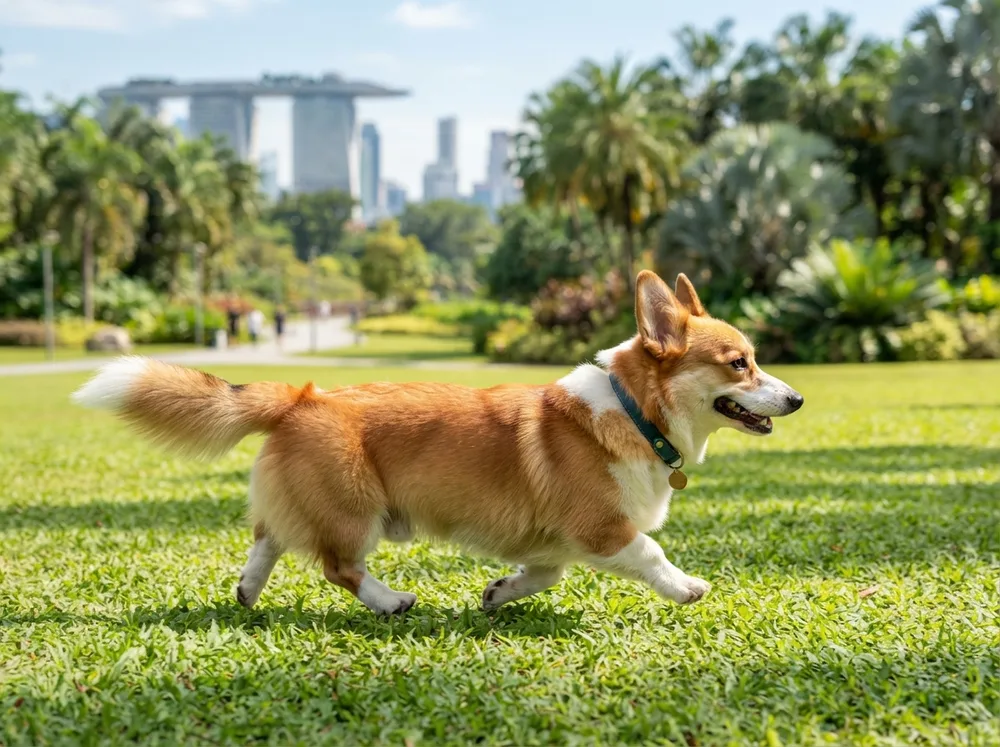
A Corgi is a short-legged herding dog from Wales, bred to drive cattle by nipping at their heels. The name comes from the Welsh cor (dwarf) and ci (dog). It is two breeds, not one: the Pembroke Welsh Corgi and the larger, always-tailed Cardigan Welsh Corgi. Adults stand 25–32cm and weigh 10–17kg by breed, and are commonly cited as living 12–15 years.
So what is a Corgi, exactly?
A Corgi is a Welsh herding dog built low to the ground, bred to move cattle by nipping at their heels and ducking the kick that came back. The name is Welsh and refreshingly literal: cor meaning dwarf, ci meaning dog. Dwarf dog. The legs are not a deformity or a designer choice, they are the job description.
The part that surprises most people is that "Corgi" is not one breed. It is two. The Pembroke Welsh Corgi is the smaller, pointier-eared one you have seen in every photograph, and it is effectively the only Corgi placed in Singapore. The Cardigan Welsh Corgi is the older breed, heavier in bone, always carrying a full tail, and available in a wider colour range. They are separate breeds with separate standards, not two sizes of the same dog.
Everything else about the breed follows from the herding job. The double coat is weatherproofing for a Welsh hillside, which is why it sheds the way it does. The bark is a working tool, which is why it is louder than the dog is tall. The energy is a cattle drover’s, which is why thirty minutes around the block does not touch it.
That gap, between the meme and the mammal, is what this Corgi breed guide is for. The Corgi dog breed is genuinely wonderful and genuinely demanding, and most of the disappointment we see locally comes from people who met the first half of that sentence and not the second.
The Corgi, at a glance
- Origin: Wales, cattle droving
- Two breeds: Pembroke and Cardigan
- Pembroke: roughly 10–13 kg, 25–30 cm
- Cardigan: roughly 14–17 kg, 26–32 cm
- Lifespan: commonly cited 12–15 years
- Coat: weatherproof double coat, heavy shedder
- Singapore: NOT an HDB approved breed
- Local all-in price: $3,288–$4,488
Two breeds wearing the same name
There are exactly two types of Corgi, and that is the whole list. People search for corgi types expecting a menu of five or six varieties; there are two recognised breeds and a handful of coat colours, nothing more.
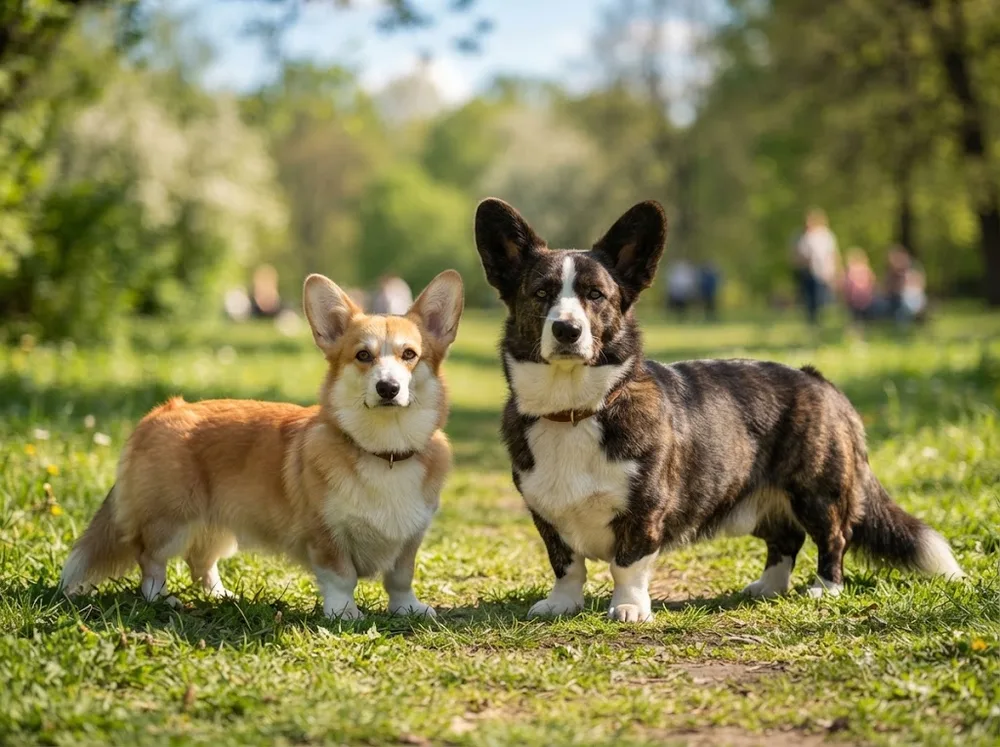
If you only ever meet one Corgi in Singapore, it will be a Pembroke. The Cardigan is genuinely rare here, and the two are easy to tell apart once you know what to look at: the tail first, then the ears, then the bone.
The rear end deserves its own sentence, because "Corgi butt" is a genuine search term and a genuine feature: the dense coat over a broad, low-slung backside produces the wiggle the breed is famous for. Ears, incidentally, are erect, not dropped, whatever one widely-read local page claims.
The Pembroke is the breed that rode the royal association to global fame. Queen Elizabeth II kept more than thirty of them across her reign, and that visibility, rather than anything about temperament, is why the Pembroke became the default Corgi in the public imagination.
The Cardigan is the older of the two and carries a full, low-set tail as standard. It also permits colours the Pembroke does not, including blue merle, which matters for a reason we come back to below.
We place Pembrokes only. The Cardigan appears here as education, not as a product, and if you want the full side-by-side, our guide on the two breeds side by side goes deeper than this section can.
| Pembroke Welsh Corgi | Cardigan Welsh Corgi | |
|---|---|---|
| Tail | Natural tail, natural bobtail, or historically docked | Always a full, low-set tail |
| Ears | Smaller, more pointed | Larger, more rounded |
| Weight | Roughly 10–13 kg | Roughly 14–17 kg |
| Colours | Red, sable, tricolour, black and tan | Wider range, including blue merle |
| Temperament | Outgoing, attention-seeking | Steadier, more reserved with strangers |
| In Singapore | The market default | Rarely available |
Where the Corgi actually comes from
Welsh farmers needed a dog that could move cattle across open ground without being killed doing it. The answer was a dog built low enough to snap at a heel and then drop under the hoof that swung back. Herding by nipping is called heeling, and the Corgi is one of the oldest surviving heelers.
A Welsh cattle dog is referenced as far back as the eleventh century, and the breed is the only herding dog indigenous to Wales. Both Corgis worked cattle, geese and sheep long before either was a companion animal, and the Pembroke was only formally recognised as distinct from the Cardigan in the twentieth century.
One correction worth making, because it has been copied across a surprising number of Singapore pet pages: Corgis did not pull carts in the Swiss Alps. That is a different breed entirely, and the claim appears on at least one page currently ranking on the first page of Google here. Corgis are Welsh cattle drovers. That is the whole story.
Why does the history matter to a buyer in Singapore in 2026? Because a dog bred for a specific job arrives with that job still installed. The instinct did not switch off when the breed moved indoors.
The legs are not a design quirk. They are what let a small dog bite a cow and live.
How big does a Corgi get?
A Corgi is a medium dog on short legs, not a small dog. This trips up more Singapore buyers than anything except the housing rules, because the height suggests a lapdog and the weight says otherwise.
Adult Corgi weight and Corgi height both depend on which of the two breeds you are looking at. A Pembroke typically runs around ten to thirteen kilograms and stands twenty-five to thirty centimetres at the shoulder. A Cardigan is heavier, roughly fourteen to seventeen kilograms, standing twenty-six to thirty-two centimetres.
Published figures disagree, and we would rather say so than pick one and pretend. Google’s knowledge panel gives the Pembroke as around twelve kilograms and the Cardigan as fourteen to seventeen; Wikipedia gives the Pembroke as eleven to fourteen; at least one Singapore seller page averages the two breeds together into a single "10 to 15 kg" figure, which is not a number that describes either breed accurately.
Corgi lifespan runs into the same problem. Twelve to fifteen years is the most commonly cited range and it is what Google’s knowledge panel shows for both breeds, but reputable sources also publish twelve to thirteen, and one local page claims ten to twelve. We publish it as commonly cited rather than asserting a figure we cannot source, and your vet is a better guide than any breed page for the dog actually in front of you.
10–13 kg
Pembroke adult weight
14–17 kg
Cardigan adult weight
25–32 cm
shoulder height
12–15 yrs
commonly cited lifespan
Coat, colours and the fluffy Corgi
Corgi colours in the Pembroke are red and white, sable, tricolour, and black and tan. All of them are standard, none is rare in any way that should change a price, and we do not run rare-colour surcharges. We place the red and white Corgi, the tricolour Corgi, and the fluffy.
The fluffy is a long-coated Pembroke: feathered ears, chest and trousers, produced by a recessive coat gene. Fluffies are lovely and they are honestly harder work, not a premium tier. More coat means more brushing and more matting, not less shedding. Anyone selling you a fluffy at a markup is charging you extra for additional grooming.
Owners who actually live with one tend to agree, often more bluntly than we would put it: the recurring line in Corgi communities is that a fluffy coat is a great deal of work and that fluffies should arguably cost less, not more, with deliberate fluffy breeding at a premium treated as a warning sign about the seller.
Then there is merle, and here we are blunt. Merle does not occur naturally in the Pembroke. A dog advertised as a "merle Pembroke" indicates crossbreeding somewhere recent, whatever the seller says. Beyond that, merle-to-merle pairings carry documented risk of congenital deafness and eye defects, which is why the pattern is chased by people selling photographs rather than dogs.
We never place merle Corgis. Not at a premium, not on request, not as a special order. No colour is worth that risk.
Colour claims that should stop a sale
- "Rare merle Pembroke" — merle does not occur naturally in the breed
- "Premium colour" pricing — no Pembroke colour justifies a surcharge
- "Fluffy, so more expensive" — a fluffy means more grooming, not more value
- "Miniature Corgi" — there is no such recognised breed or size class
Why most Corgis online have no tail, and ours do
Search for a Corgi and you will mostly see a dog with no tail. Google’s own AI summary describes the Pembroke as having a "naturally short or docked tail", and the page currently ranking first in Singapore for corgi puppy searches literally sells a product listed as "Corgi (Bob Tail)".
Here is what is actually going on. Pembrokes were historically docked, a human convention inherited from the droving era rather than anything the dog was born with. Separately, a genuine natural bobtail gene exists in some Pembroke lines, so a small number of Pembrokes really are born with a short tail. Cardigans always carry a full tail. Those are three different things that the internet routinely blends into one.
Our puppies keep their natural tails. An undocked tail, the full fox-brush the breed was born with. We mention it not because a tail changes how good a dog is, but because most Corgi imagery in this market shows a docked dog, and a buyer deserves to know that the version they have been looking at is not the default version of the animal.
We make no claim about docking law in Singapore, because we have not verified one, and a guide that invents a regulation to sound authoritative is worse than a guide that says it does not know.
Corgi temperament: a cattle dog in a costume
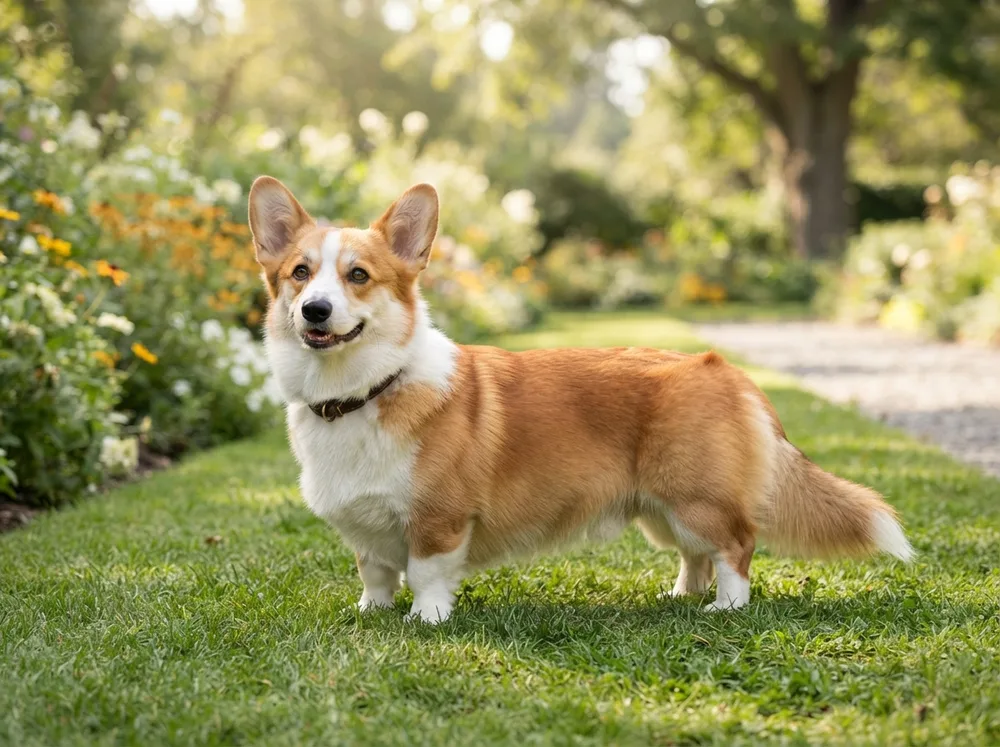
The single most useful thing anyone can tell you about this breed: the internet’s Corgi is a meme, the real one is a cattle dog. Buy the herder, not the bread loaf, or do not buy one.
What you actually get is confident, funny, bossy and extremely attached. A Corgi will follow you room to room, hold strong opinions about the household schedule, and learn anything you can be bothered to teach it, because it is intelligent and enormously food-motivated. That last trait cuts both ways: it makes training easy and it makes weight management a daily discipline.
The herding instinct arrives switched on. With no cattle available, it redirects onto whatever moves: ankles, running children, the robot vacuum, occasionally a dinner guest. This is trainable and it is normal, and it is the reason we are straight with families about school-age children being an easier fit than toddlers.
Do they bark? Yes, and Corgi barking is the complaint that follows the shedding complaint. A big-dog bark from a knee-high dog, and an opinion about when to use it. Alert barking is the working instinct doing its job rather than a fault to be trained out entirely, though it can absolutely be managed. In dense housing with close neighbours, this is worth thinking about before rather than after.
Can they be left alone? For a normal working day, yes, once adult and properly exercised first. What a Corgi cannot tolerate is being alone and under-stimulated. A bored herding breed with nothing to do will find employment, and you will not like the role it picks.
An under-exercised Corgi in a condo is a demolition franchise with opinions.
How much exercise a Corgi really needs
Two proper walks a day, plus play, plus brain work. Every day. Not thirty minutes around the block. Corgi exercise is the requirement people most often underestimate, because the legs suggest a dog that tires quickly and the engine above them says otherwise.
We are specific about this because the advice circulating locally is not. One Singapore page currently ranking on page one states "Exercise needs: Moderate level. A 30 minutes per day exercise is enough", then contradicts itself further down the same page with thirty to sixty minutes. Neither figure describes what a working herding breed actually needs.
In Singapore there is a second layer: a coat evolved for Welsh winters, worn at one degree north. Walks belong in the cool windows, early morning and after dark, never the middle of the day. Press the back of your hand to the pavement for seven seconds before you set off; if you cannot hold it there, your dog cannot walk on it.
Mental work tires a herding brain faster than distance does, which is genuinely good news for condo living. Ten minutes of trick training or a puzzle feeder can do more than an extra kilometre. The community here is real, too: over a hundred Corgis have turned up to a single meet at Sentosa, and East Coast Park is thick with them at dawn.
The daily budget, honestly
- Two real walks, in the cool windows, not midday
- Seven-second pavement test before every walk
- Ten to fifteen minutes of training or puzzle work
- Ground-level play over jumping games, to protect the back
- Skipped days compound: the behaviour bill arrives later
The shedding, told properly
This is the section most breed guides give one line and we give a whole section, because Corgi shedding is the single most common ownership regret, and nobody should buy one without hearing it plainly.
The Corgi carries a double coat: a coarse guard layer over a dense insulating undercoat. It sheds year-round, and roughly twice a year it blows the undercoat, which means two to four weeks of fur coming out in visible tufts, everywhere, continuously. First-time owners consistently describe it as worse than they were led to expect.
Owners have their own word for the fine hair that ends up on every surface: corgi glitter. The running joke in the breed’s own communities is that Corgis shed twice a year, July to December and January to June. It is a joke that stops being funny at the point of purchase, which is why it belongs on this page rather than in a footnote.
Singapore adds a twist that no overseas breed guide covers. With no true winter and permanent aircon, the seasonal trigger flattens out, so the cycle becomes less predictable and often more drawn out than the tidy "twice a year" line suggests.
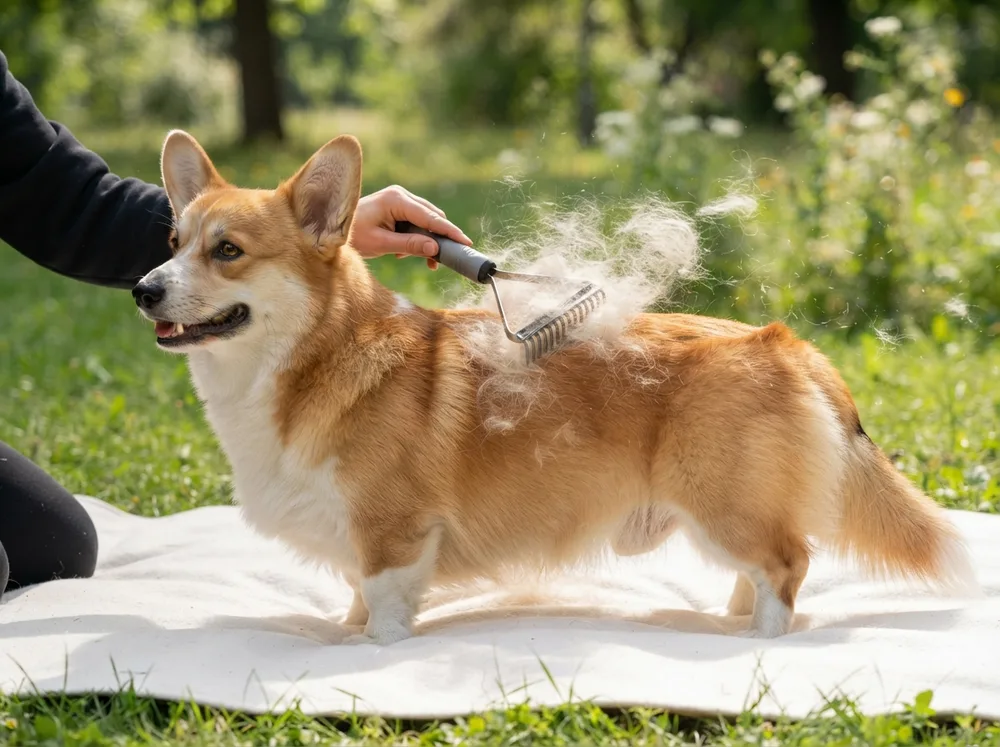
The one rule that matters most: never shave a double coat. It feels logical in this climate and it is wrong. The undercoat insulates in both directions, keeping heat out as well as in, and a shaved coat regrows badly while raising the dog’s heat risk. Deshedding is the answer, clipping is not. An undercoat rake and a slicker do the work; most other tools are theatre.
We have this conversation at every handover, before money changes hands. If fur on the sofa is a dealbreaker, this is the wrong breed, and we would rather tell you now. The full mechanics live in our guide to how the double coat behaves in the tropics.
Corgi health: the back, the hips, the weight
The long, low build that makes the breed charming is also where its risks concentrate. The Corgi belongs to the same short-legged family as the Dachshund, and with that comes documented risk of intervertebral disc disease, where a disc between the vertebrae degenerates and can press on the spinal cord.
We publish no prevalence percentage here, deliberately. Corgi-specific figures are thin, and the widely-quoted Dachshund statistic does not transfer to this breed. What is consistently reported is that the Pembroke sits among the predisposed breeds at meaningfully lower rates than the Dachshund. The behaviour that follows matters more than the number: protect the back and build the household around it from day one.
Hip dysplasia is the second theme, heritable and screenable. Formal hip scoring of breeding stock is what the schemes exist for, and asking a seller what is known about a litter’s parentage on this front is a fair question to put to anyone, us included. Degenerative myelopathy is also documented in Pembrokes; it is a question for your vet rather than a shop page.
And then the one you control completely. Weight is the multiplier on all of it: the spine, the hips and the heat tolerance, simultaneously. The loaf-and-sploot corner of the internet has quietly normalised an unhealthy build. Fat Corgis are not cute. The long low chassis forgives nothing, and every excess kilogram lands somewhere that cannot afford it.
Back signs that mean a vet, today
- Sudden refusal to jump, climb or use stairs
- Hunched posture or a tense, tucked belly
- Yelping when touched or lifted
- Hind-leg wobble, crossed steps or toe-dragging
Can you actually own a Corgi in Singapore?
Yes in private housing. No in an HDB flat, because the breed is not HDB approved. This is the most important paragraph on this page for anyone reading it from Singapore, and it is the one most breed guides skip entirely.
HDB approves 62 dog breeds for flats under the Housing and Development (Animals) Rules 2024. Neither the Pembroke nor the Cardigan Welsh Corgi appears anywhere on that list. We re-checked the full list on hdb.gov.sg in July 2026 and searched it for "corgi", "pembroke" and "cardigan": zero matches on all three. The list is a fixed roll of approved breeds, not a size test, so the Corgi being small changes nothing.
There is no appeal route, and no obedience certificate that converts an unapproved breed into an approved one. Keeping one in a flat risks a fine of up to $4,000 and a rehoming order for the dog.
The cross-breed question comes up constantly and the answer disappoints people. The list’s final item approves crosses of two approved breeds. Because the Corgi is not an approved breed to begin with, a Corgi cross fails automatically, whatever the other parent is and however small the puppy looks.
Our own policy follows from this. We ask what housing you live in before we talk about price, and we do not sell a Corgi to an HDB address. Refusing that sale is the kindest thing we do for flat dwellers, because a dog living one complaint away from removal is not living in a home, it is running down a clock. The full breakdown, with the list quoted, is on our page covering the HDB approved-breeds question in full.
The housing facts
- HDB approved breeds: 62, none is a Corgi
- Verified against hdb.gov.sg, July 2026
- Penalty: fine up to $4,000 + rehoming order
- Corgi crosses: also not approved
- Private housing: up to 3 dogs (AVS)
- Our policy: housing asked before price
What a Corgi puppy is actually like
A Corgi puppy is a small, extremely fast, surprisingly strong animal that arrives with the herding software already running. It does not develop the instinct later. It shows up with it.
Ours go home around week nine, after vaccinations at weeks six and eight and deworming at each visit, with boosters continuing at week twelve and an optional week sixteen. That timing is not arbitrary: it lands the puppy in your home during the socialisation window, which is exactly when redirecting the nipping instinct is easiest and most durable.
Expect mouthiness, expect speed, and expect the ankle interest to appear early. Redirect it onto a toy and a game the first week and it becomes a party trick. Ignore it for three months and it becomes a habit you are negotiating with a strong-willed adolescent.
One thing that catches people out: the puppy coat lies to you. A twelve-week-old Corgi sheds far less than the adult will, so early impressions badly underestimate what is coming. The coat changes through the first year and the first real blow usually arrives well after the buying decision is made.
What a Corgi costs in Singapore
Ours are $3,288–$4,488 all-in. All-in means the vet health check, vaccinations on schedule, deworming, microchip, breed identification papers, a thirty-item starter kit valued above $500, free home delivery with playpen setup, a free first training lesson with an AVS-certified trainer, and the dog licence handled at purchase. Nothing gets added at the door.
We publish that number because the local market does not. Listing sites quote $3,000 to $9,000. One kennel’s guide says $4,000 to $7,000. A widely-shared insurance blog claims $7,880 to $8,500. And the page currently ranking first in Singapore for corgi puppy searches has a price sentence where the figure fails to render at all, so it states no price whatsoever.
Why is a Corgi expensive? Three honest reasons: the breed is not locally common, so most Singapore Corgis are legally imported with real transport and health-clearance costs; a licensed shop pays for the health work before placement rather than after; and a licensed operator cannot price against smuggled stock.
That last point has a cost attached. A local buyer paid $6,400 for two Corgi puppies from an unlicensed seller and neither survived the first week. Our licence, AS24J00046, is verifiable on the AVS public registry in about thirty seconds, and checking any seller’s licence number before money moves is the cheapest protection available. The itemised version is on our page covering what a Corgi costs, itemised.
$3,288
all-in, published
$3,000–$9,000
typical market quotes
Week 9
puppy goes home
100+
Corgis placed by us
The downsides, and who a Corgi is not for
Every honest breed guide needs this section, and almost none of the pages competing for this search have one. Here are the five real downsides, without softening.
The fur is relentless, and the twice-yearly blow is worse than you are expecting. The bark is loud and the dog has opinions about deploying it. The herding instinct lands on ankles before it is redirected. The exercise requirement does not shrink to match the legs. And the housing law rules the breed out for roughly eighty percent of Singapore households.
So who should not get one? Anyone in an HDB flat, without exception. Anyone who cannot commit two real walks a day, every day, in a climate that makes them inconvenient. Anyone for whom fur on the sofa is a genuine dealbreaker. Anyone who wants a quiet dog. And anyone buying the meme rather than the working animal underneath it.
A Corgi returned at month three is a failure we take personally, which is why the honest no comes before the sale rather than after it. If the list above made you grin rather than wince, you are probably the right home, and the trade is a good one: more fur, more voice and more energy than the internet promised, in exchange for more dog per kilogram than almost anything else on four legs.
| Your situation | The honest answer |
|---|---|
| HDB flat | No. Not legally, not via appeal, not as a cross |
| Private housing, two walks daily, fine with fur | Yes. This is the breed at its best |
| Private housing, long unpredictable hours | Not yet. The exercise gap becomes a behaviour problem |
| Fur is a dealbreaker | No, regardless of housing. This will not improve |
| Children under five | Wait, or commit to redirecting the nip deliberately |
| Want a quiet, low-energy dog | Wrong breed. Look at the approved small breeds instead |
Your guide to every Corgi question
Frequently asked questions
Why is Corgi not allowed in HDB?
Because the breed is not on the list. HDB approves 62 dog breeds for flats under the Housing and Development (Animals) Rules 2024, and neither the Pembroke nor the Cardigan Welsh Corgi appears on it (verified against hdb.gov.sg, July 2026). It is a fixed roll of approved breeds rather than a size test, so a Corgi being small changes nothing.
Are Corgis allowed in Singapore?
Yes. Corgis are perfectly legal to own here. The restriction is on housing, not the breed: a Corgi may live in private housing such as a condominium or landed home, where AVS permits up to three dogs, but it cannot legally live in an HDB flat because it is not an HDB approved breed.
How much does a Corgi cost in Singapore?
Ours are $3,288–$4,488 all-in, which covers the vet health check, vaccinations, deworming, microchip, a 30-item starter kit, free delivery with playpen setup, a free first training lesson and the licence handled at purchase. Market quotes elsewhere run from $3,000 to $9,000, usually without itemising what is included.
Is Corgi a good family dog?
Yes, for the right family. A Corgi is affectionate, funny and deeply attached to its people, and it does well with school-age children who enjoy training it. The caveats are real: it herds, so ankles get nipped until the instinct is redirected, it is loud, and it needs genuine daily exercise.
What is the downside to Corgis?
Five honest ones. The shedding is relentless and the twice-yearly coat blow surprises most new owners. The bark is loud and opinionated. The herding instinct lands on ankles first. The exercise requirement does not shrink to match the legs. And in Singapore the breed cannot legally live in an HDB flat.
Does a Corgi bark a lot?
Yes. A Corgi has a big-dog bark and firm opinions about when to use it, because alert barking was part of the herding job rather than a fault. It responds well to early redirection work, but anyone living with close neighbours should factor the voice in before buying, not after.
Can Corgis be left home alone?
For a normal working day, yes, once the dog is adult and has been properly exercised first. Corgis are attached but not fragile. What they cannot tolerate is being alone and under-stimulated: a bored herding breed will bark, chew and invent its own job. A morning walk and a puzzle feeder matter more than the hours.
Is a corgi a high maintenance dog?
On grooming and exercise, yes. The double coat sheds year-round and blows out heavily twice a year, and the breed needs real daily walks plus brain work. On temperament it is easy: intelligent, food-motivated and quick to learn. The maintenance sits in the coat and the energy, not the character.
Meet your Corgi
Come say hello at Balestier
2 Balestier Road #01-701, Singapore 320002 · Weekdays 12pm–6pm · Weekends 10am–6pm. Or message us first: tell us about your home and routine, and we'll tell you honestly if a Corgi fits.
Live in private housing?
See which Corgi puppies are in the shop this week, with published pricing.
See available puppies