Health & heat
The double coat at one degree north: a treaty, not a problem
Coat physics, walk windows, the pavement test, and the heat-stress ladder: everything a Welsh jacket needs to thrive in a sauna.
Nelson and Kim, Curious Tails · AVS licence AS24J00046
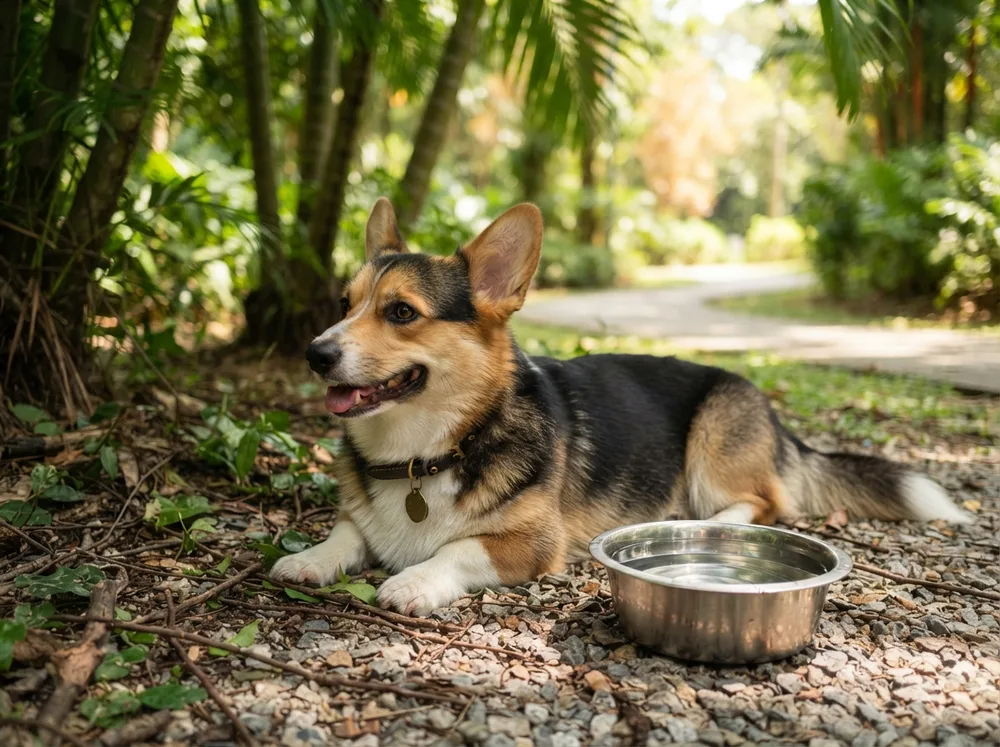
How do corgis cope with Singapore heat?
On a strict treaty: walks before 9am and after 6pm, the seven-second pavement test in between, water past twenty minutes, an aircon or cool-tile siesta zone, lean weight, and a raked, never shaved double coat, whose trapped-air layer actually slows heat gain. Learn the heat-stress ladder; heatstroke response is water, airflow and the vet now.
A Welsh coat at one degree north: the honest starting point
Let us answer the question buyers actually whisper: yes, a double-coated herding breed can live well in Singapore, our hundred-plus placements are the ledger, but only in households that respect the physics, because the corgi is wearing hill-country equipment in a sauna and cannot take the jacket off. The double coat is a two-layer system: a dense, woolly undercoat that traps air, under a longer jacket of guard hairs that sheds rain and blocks sun.
That trapped-air layer is genuine two-way insulation, it slows heat loss in a Welsh winter and, crucially, slows heat gain in a Singapore noon, while the guard hairs keep UV off skin that has never needed melanin. A well-maintained double coat is climate equipment that works both directions.
Which is the whole case behind the rule this site repeats like a chorus: never shave a double coat. Shaving deletes the air gap and the sunshade in one pass, exposes pink skin to the equatorial sky, does nothing to the shedding (which continues at stubble length), and frequently ruins the regrowth into matted "clip coat".
The genuinely cooler corgi is the raked corgi: dead undercoat stripped out three times a week so the air layer stays lofted and functional. Coat maintenance in the tropics is not grooming vanity; it is thermal engineering, and our deshedding guide is secretly this page's toolkit.
Coat physics, fast
- Undercoat: trapped-air insulation, both ways
- Guard hairs: sun and rain shield
- Raked coat = functional cooling system
- Shaved coat = sunburn + same shedding
- Dogs cool by panting, not sweating
- Humidity blunts panting: SG’s real enemy
The daily protocol: windows, pavement, water, aircon
The workable corgi day here runs on a dawn-and-dusk chassis. Walk windows: out before roughly 9am and after roughly 6pm, when air temperature drops and, just as important, the ground stops radiating; the corgi's low ride height parks its belly half a metre closer to baking asphalt than a retriever's. Between the windows, the seven-second pavement test arbitrates every borderline case: back of your hand on the pavement for seven seconds, and if you cannot hold it comfortably, the surface will burn paw pads and the walk waits.
Water travels on any walk past twenty minutes, offered at every shade stop rather than saved for distress. Route choice does quiet work too: grass verges and shaded park connectors over exposed asphalt, sniff-heavy ambles over forced-march pace, and the midday toilet break kept to exactly that, minutes, in shade, done.
Indoors, aircon is not a luxury for this breed here; it is the siesta infrastructure. The dog needs one reliably cool zone for the heat of the day, aircon in the low-to-mid twenties, or at minimum a fan-swept tile floor away from western sun, and most corgis self-install on the coolest tile in the house with professional accuracy (the belly-flat "sploot" on cold tile is genuine heat management, let it happen).
A cooling mat earns its modest cost as a portable cold tile; cooling vests are marginal here, evaporative types work poorly in saturated humidity, and neither substitutes for schedule and shade. Rainy-day or haze-day energy goes indoors: puzzle feeders, training games, corridor fetch, the brain-work half of the exercise budget our exercise guide details, which conveniently needs no weather at all.
Dawn and dusk belong to the corgi. Noon belongs to the coldest tile in the house, and that is the treaty.
Reading the dog: the heat-stress ladder
Every corgi household learns the ladder, because dogs hide distress until they cannot. Rung one, normal: rhythmic open-mouth panting on a warm walk, tongue normal shape, dog still keen, this is the cooling system working. Rung two, early stress, act now: heavier relentless panting, the tongue widening and flattening into a ladle shape, drool beyond the usual, the dog drifting toward every shadow, lagging where it usually leads.
Response: walk over, shade immediately, water offered in small amounts, rest until breathing settles, then home the short way and into the aircon; no pushing through, and note what conditions produced it.
Rung three, heatstroke, emergency: frantic gasping, brick-red or purplish gums, thick ropey drool, wobbling or disorientation, vomiting or diarrhoea, collapse. Response: this is a race, move to shade or aircon, pour room-temperature (not iced) water over neck, belly, armpits and paws, airflow across the wet coat, and go to the vet now, calling ahead, because heatstroke damages organs by the minute and outcomes track speed of care.
The risk multipliers deserve their own sentence each. Weight: fat is insulation of exactly the wrong kind, and the meme-round corgi hits rung two in half the conditions a lean one shrugs off, one more entry in the waistline's ledger.
The fluffy coat carries a slightly heavier thermal jacket: same rules, slightly wider margins, and even stricter fidelity to the never-shave law, since long coats regrow worst. The car: never alone in a parked car, not for minutes, not in shade, not with windows cracked; tropical car cabins reach lethal temperatures with astonishing speed, and this rule has no exceptions anywhere on earth, least of all here.
Cooling that works, theatre that does not, and the good news
The buy-list, honestly sorted. Works: the undercoat rake (the number one cooling tool in the house, genuinely), a cooling mat as portable cold tile, a collapsible water bowl that lives on the leash hook, aircon or a good fan for the siesta zone, and swimming, the perfect tropical corgi sport: full exercise at zero heat load and zero spinal load, at dog pools or the sand-legal beach stretches, vest on for the low-slung swimmer.
Theatre, mostly: evaporative cooling vests (defeated by saturated humidity), iced "pupsicles" as a cooling strategy rather than a treat, wearable fans, and every product whose pitch is compensating for a schedule the owner does not want to keep. The schedule is the product. Everything else is accessories.
And the good news, delivered last because it lands better after the respect is established: corgis adapt. A Singapore-raised corgi on the dawn-dusk treaty, kept lean, raked weekly and given its cold tile, handles this climate as a settled routine rather than a crisis, and the breed's natural rhythm, athletic bursts, epic naps, fits the tropical timetable almost suspiciously well.
The failure stories the vets see are almost never "corgi in Singapore"; they are "corgi at noon", "corgi in a parked car", "shaved corgi on a beach day", "round corgi on a forced march", every one preventable by the treaty this page just wrote down. Sign it, and the Welsh jacket becomes a quirk, not a sentence.
Keep exploring
Frequently asked questions
Can corgis handle Singapore heat?
Yes, on the treaty: walks before 9am and after 6pm, the seven-second pavement test for borderline hours, water past twenty minutes, an aircon or cool-tile siesta zone, lean weight, and a raked (never shaved) coat. Hundred-plus placements say it works.
Wouldn’t shaving keep the dog cooler?
No, the opposite. The double coat’s trapped-air layer slows heat gain and the guard hairs block sun; shaving strips both at once, turns the shedding into stubble, invites sunburn and frequently wrecks the regrowth. The genuinely cooler coat is a raked one, with the dead undercoat out.
What is the seven-second pavement test?
Back of your hand on the pavement for seven seconds: if you cannot hold it comfortably, the surface burns paw pads and the walk waits. The corgi’s low belly also rides close to radiating asphalt, so the test protects more than feet.
What are the early heat stress signs?
Relentless heavy panting, a tongue flattening into a ladle, extra drool, shadow-seeking and lagging. Respond at the first sign: shade, small water, rest, then home to the aircon. Never push through.
What is the heatstroke emergency response?
Shade or aircon immediately, room-temperature water poured over neck, belly, armpits and paws, airflow across the wet coat, and the vet now, calling ahead. Brick-red gums, wobbling, vomiting or collapse mean minutes matter.
Do cooling mats and vests work?
Mats, yes: a portable cold tile most corgis adopt instantly. Evaporative vests, barely: saturated humidity defeats them. Nothing replaces the schedule, the shade and the rake.
Is aircon compulsory?
A reliably cool siesta zone is: aircon in the low-to-mid twenties, or at minimum a fan-swept tile floor away from afternoon sun. The dog will find the coolest tile itself; your job is making sure one exists.
Can my corgi swim to cool off?
Ideal: full exercise at zero heat and zero spinal load. Use a dog vest (the build is not buoyant), start shallow, and favour dog pools or sand-legal beach stretches in the cool windows.
Meet your Corgi
Come say hello at Balestier
2 Balestier Road #01-701, Singapore 320002 · Weekdays 12pm–6pm · Weekends 10am–6pm. Or message us first: tell us about your home and routine, and we'll tell you honestly if a Corgi fits.
Still deciding?
Read the price guide first: every dollar explained, no surprises at the shop.
See the price guide