Buying & living
The first week home: architecture, not entertainment
Night one, the toilet treaty, the two-minute curriculum and the quiet that builds a confident dog: day zero to day seven, honestly.
Nelson and Kim, Curious Tails · AVS licence AS24J00046
How do I handle a corgi puppy’s first week?
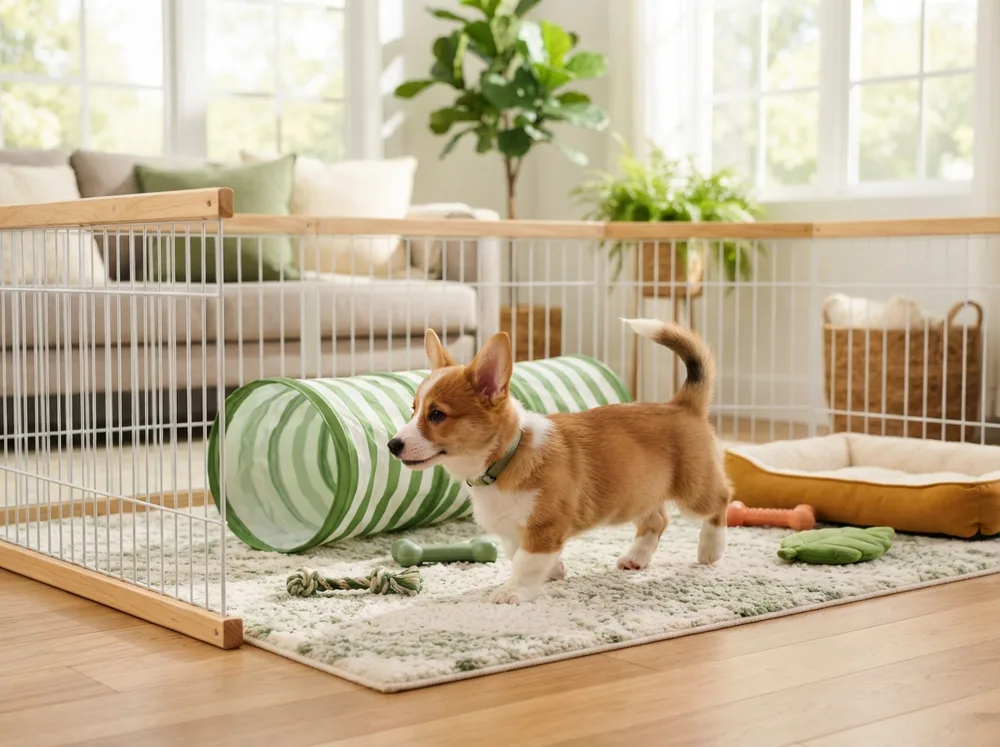
Keep it quiet: pen pre-set (ours arrives assembled with the starter kit), household only, sleep-heavy days. Night one: pen in your bedroom, respond to need not noise. Toilet by prediction every 1–2 waking hours with parties for success. Two-minute training sessions from day two, week-12 jab booked, and the care line on speed dial for red flags.
Day zero: what delivery day already handles
If your puppy comes from us, day zero arrives pre-assembled, which is the point of the all-in model.
At week 9, the classic homing age, vaccinations at weeks six and eight done, dewormed, microchipped, vet-checked, your corgi arrives by free home delivery, and the delivery includes the playpen setup: pen assembled in the right spot (away from aircon draft and afternoon sun, sight line to family traffic, on wipeable flooring), bed at one end, water and pee zone at the other, and the 30-item starter kit unpacked around it, food the puppy is already eating, bowls, harness, leash, grooming basics, toys, pads.
We walk the household through the first-night routine at the door, file nothing new (your licence was sorted at purchase), and leave you with the care advice line saved into your phone. Buyers from elsewhere: replicate this checklist yourself before the puppy arrives, because assembling a playpen around a crying puppy at 9pm is nobody's founding memory.
Then, the most counterintuitive instruction of the week: do very little. The urge is a welcome parade, grandparents summoned, friends queued, every room toured. Resist it.
The puppy has just left its litter, its scents and its whole world; the kindest day zero is quiet: pen, water, a meal, a soft toy, short calm visits from household members only, and sleep, which a nine-week puppy needs sixteen-plus hours of. The corgi you want in year ten is built on a week-one foundation of safety, and safety, to a puppy, smells like boredom.
Delivery day, done right
- Week ~9 homing, health work complete
- Playpen sited and assembled for you
- Starter kit: 30 items, unpacked
- Same food as the shop: no diet switch
- Care line saved before we leave
- Day zero visitors: household only
Night one, honestly, and the sleep architecture
Night crying has a reputation, and for a new puppy the reputation is earned: most puppies cry, some operatically, and the corgi's future big-dog voice auditions early. The protocol that shortens it from a week to a night or two: sleep the pen or crate in your bedroom for the first stretch, or yourself on the sofa beside the pen, because a puppy that can hear you breathing is a puppy whose alarm system stands down.
Warm bed, a soft toy, an item carrying the litter's scent if you took our blanket-swap offer, last toilet trip at 11pm, then lights out and, this is the hard part, respond to need, not to noise: a 3am cry that stops when you rest a hand near the pen was loneliness (fine, comfort briefly, no party); one that continues with circling is a toilet run (silent, businesslike, straight back to bed).
What breaks the system is inconsistency with drama: lifting the puppy into your bed at 4am on night two teaches a lesson your mattress will attend for twelve years, unless that was the plan all along, in which case proceed with our blessing and a lint roller.
Nights three through seven typically settle fast, and you can migrate the pen toward its permanent spot gradually if bedroom-sharing was temporary. Daytime sleep matters just as much and gets less respect: a nine-week puppy should be asleep more than awake, overtired puppies present as tiny furious sharks (the "witching hour" nip-fest is 90% exhaustion), and the fix is enforced pen naps after every meal and play burst, not more stimulation.
The household rule that makes it work, especially with children: the pen is sanctuary, nobody reaches in to wake a sleeping puppy, ever. That single rule prevents half the behaviour problems this site's training cluster exists to fix.
Respond to need, not to noise, and let the puppy sleep more than it parties. Week one is architecture, not entertainment.
The daily rhythm: toilet, meals, and the two-minute curriculum
Toilet training starts at hour one and runs on prediction, not correction. A nine-week bladder needs emptying roughly every one to two waking hours, plus reliably: on waking, after every meal, after every play burst, before bed. Carry or lead the puppy to the chosen spot, pee pad in the pen zone at first, transitioning to the downstairs grass patch as vaccinations complete, wait silently, and the instant success happens, throw a tiny party: treat, warm voice, done.
Misses get zero commentary and a quiet cleanup with enzyme spray (in the kit); a puppy scolded at a puddle learns only to hide the next one. Expect real progress in days, reliability in weeks, and the occasional relapse on rainy days as a term of the treaty.
Meals run three times daily at this age, same food as the shop fed (the kit ships with it; diet switches wait until week two-plus and happen gradually across days to spare the digestion), measured portions per the label, bowl down fifteen minutes, then up. And the two-minute curriculum begins day two: name response (say it, treat the head-turn), collar and harness worn during dinner, one-syllable sit lured with a treat, brief gentle handling of paws and ears per the grooming guide's conditioning plan, and the towel-and-rake introduction at minute-scale.
Two minutes, twice a day, party atmosphere: at this age you are not training behaviours so much as installing the single meta-lesson that humans are the source of all good things and learning pays. The free AVS-certified trainer session lands inside this window, use it live, with your actual household, on your actual floor.
The week in arc, the red flags, and the care line
Settling in follows a schedule of sorts, and bonding follows the schedule. The week's arc, day by loose day: days one and two, quiet establishment, household only, pen-centric, sleep-heavy. Days three and four, the confidence bloom, first supervised whole-home explorations (one room at a time, cables managed, shoes elevated: normal chewing is teething, and the kit's chew toys are the legal alternative), the two-minute curriculum humming.
Days five to seven, gentle horizon-widening: one calm visitor at a time (shoes off, sit on the floor, let the puppy approach), carried exposure at the lobby or void deck during quiet hours, sights and sounds banked from your arms since ground-level public spaces wait for vaccination clearance, and the first alone-time drills, five minutes in the pen with a stuffed chew while you leave the room, building the muscle that prevents year-one separation drama.
Book the week 12 vaccination before the week ends; an early hello vet visit to your chosen clinic, treats flowing and nothing scary happening, is the cheapest vet-phobia insurance ever sold.
Red flags that skip the wait-and-see queue, week one being no time for stoicism: refusing food beyond a meal or two, lethargy beyond normal puppy sleep, vomiting or diarrhoea beyond one soft stool, coughing, discharge from eyes or nose, or crying that reads as pain rather than protest. Call the care line first at +65 8220 6408, that is what it is for, and we will tell you honestly whether it is a 9am clinic matter or a tonight matter.
Then relax, genuinely: week one's job is not a finished dog, it is a puppy that ends day seven feeling safe, sleeping soundly, toileting mostly in the right postcode and convinced your family is the best thing that ever happened to it. The herding, the training montages, the beach debut: all of that has twelve years of runway. This week, you are just building the ground it takes off from.
Keep exploring
Frequently asked questions
What should day one with a corgi puppy look like?
Quiet. Pen, water, a meal, household members only, and lots of sleep, sixteen-plus hours is normal at nine weeks. The welcome parade waits; safety is the whole curriculum of day one.
Will the puppy cry on night one?
Probably, and loudly. Sleep the pen in your bedroom, warm bed, litter-scented item, 11pm toilet trip, then respond to need (toilet runs, silent) not noise (brief calm comfort). Most puppies settle within two or three nights.
How do I start toilet training?
Prediction, not correction: to the spot on waking, after meals, after play, before bed, roughly every one to two waking hours. Party at success, silence at misses, enzyme spray on accidents. Days to progress, weeks to reliability.
When can the puppy go outside?
Ground-level public spaces wait for vaccination clearance (week 12 jab, then as your vet advises). Meanwhile, bank socialisation from your arms: lobby sounds, lift rides, street watching at quiet hours.
When does training start?
Day two, at two minutes a session: name response, sit, harness-wearing at dinner, paw and ear handling, the towel-and-rake hello. The free AVS-certified trainer session lands this week deliberately.
What chewing is normal?
All of it, teething is a full-time job. Manage cables and shoes, supply the kit’s chew toys as the legal outlet, and swap rather than scold when contraband is found.
What are the week-one red flags?
Food refusal beyond a meal or two, unusual lethargy, repeated vomiting or diarrhoea, coughing, eye or nose discharge, pain-toned crying. Call the care line first; that is precisely what it exists for.
Meet your Corgi
Come say hello at Balestier
2 Balestier Road #01-701, Singapore 320002 · Weekdays 12pm–6pm · Weekends 10am–6pm. Or message us first: tell us about your home and routine, and we'll tell you honestly if a Corgi fits.
Still deciding?
Read the price guide first: every dollar explained, no surprises at the shop.
See the price guide