Shedding & grooming
The fluffy corgi, with the caption the photos crop out
A recessive gene, a glorious coat, fifty percent more brushing, and a premium that should not exist: the whole fluffy story.
Nelson and Kim, Curious Tails · AVS licence AS24J00046
What should I know before getting a fluffy corgi?
It is a normal Pembroke with the recessive long-coat gene: same temperament, same health, ~50% more grooming (four weekly sessions, mandatory mat patrol, longer drying). Shows fault the coat; pets could not care less. It should not cost more, and with us it does not: same all-in band as every coat and colour.
What a fluffy actually is
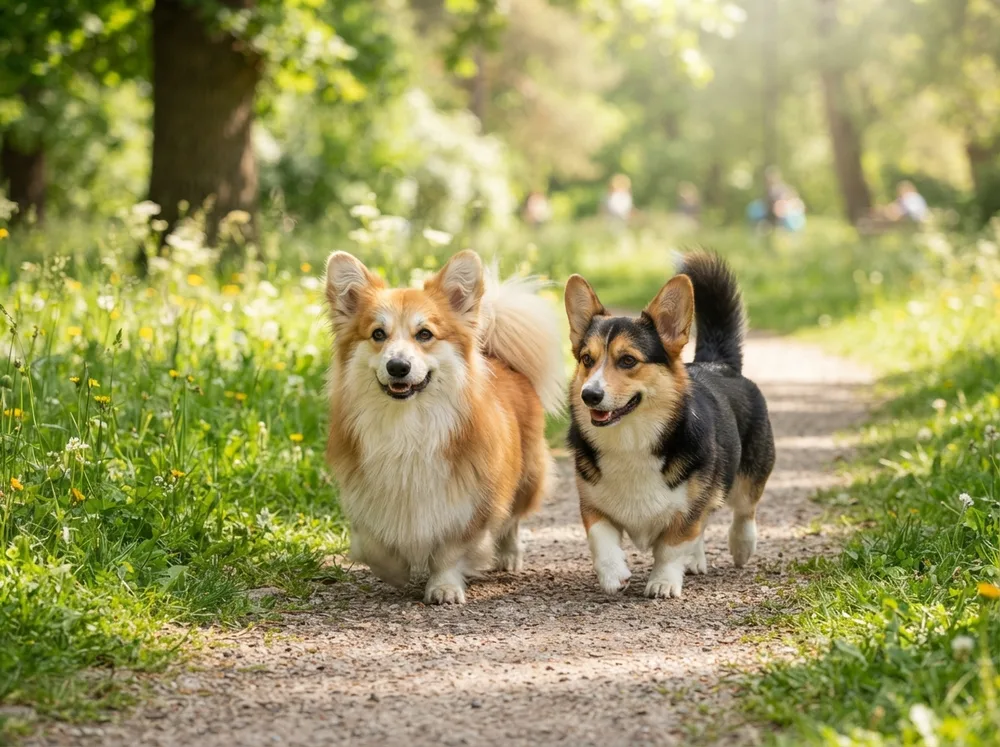
The fluffy corgi is not a breed, not a designer cross and not a rare bloodline, whatever the caption said. It is a Pembroke Welsh Corgi wearing the long-coat version of its own coat: same dog, same herding brain, same big bark, same chassis, with noticeably longer, softer fur and dramatic feathering at the ears, chest, legs, britches and tail.
The mechanism is a simple recessive gene: every corgi carries two copies of the coat-length setting, and the long-coat variant only expresses when a puppy inherits it from both parents. Two standard-coated parents who each quietly carry one long-coat copy can and regularly do produce fluffy puppies, which is why fluffies surprise breeders as often as they delight buyers, and why a fluffy in the litter says nothing suspicious about the parentage.
Spotting one early is a practised eye's game: fluffy puppies show a softer, fuzzier face and ear fringe by six to eight weeks, with wispy feathering behind the ears that standard coats lack. By twelve weeks the difference is obvious, and by the adult coat it is unmistakable, a corgi mid-way to cloud.
We stock fluffies alongside standard coats (see the puppies page for current litters), and every fluffy buyer at our counter gets this article delivered verbally before any deposit, because the fluff is glorious and the fluff is work, and only one of those facts appears on the internet.
The fluffy file
- Same breed: Pembroke, long-coat gene
- Recessive: needs a copy from each parent
- Visible by ~6–8 weeks (ear fringe first)
- Show rings fault it; pets could not care less
- Sheds the same, mats far more
- Same price as standard coat, with us
The grooming delta, honestly measured
Here is the truth the fluffy hashtag omits: the fluffy does not shed more than a standard corgi, it sheds the same prodigious undercoat wrapped in longer packaging, and the packaging changes everything about the labour. Longer fur travels further through the house, shows more on furniture, and, critically, mats, which the standard coat essentially never does.
The mat zones are predictable: behind the ears, the armpits, the britches, under the collar or harness, anywhere friction meets feathering, and in Singapore's humidity a damp mat felts overnight into something only a groomer's dematting tool or scissors can resolve.
Translate that into the calendar and the fluffy upgrade is roughly fifty percent more grooming: four brushing sessions weekly instead of three (or a five-minute daily feathering pass), the metal-comb audit promoted from optional to mandatory at every session, meaningfully longer post-bath drying, because damp feathering is the mat factory, and a standing relationship with a groomer for the fortnights when life outran the comb.
Heat management is the same protocol as any double coat, cool-window walks, shade, water, never shave, with a slightly heavier thermal jacket to respect; the never-shave rule binds fluffies hardest of all, since clipped long coats regrow worst. None of this is a warning against the fluffy. It is the price tag the photos crop out, and paid on schedule, it is fifteen extra minutes a week for the most photogenic dog you will ever own.
The fluffy sheds the same fur in longer packaging. The packaging is the workload.
The show fault that means nothing, and the premium that means less
Breed standards fault the fluffy coat, show judges will pass over a fluffy regardless of its other virtues, and a certain kind of seller spins this both directions at once: "rare non-standard coat!" for the premium, "faulted by shows!" for the discount, depending on which moves stock.
The honest reading for a companion buyer is simpler: the fault exists because a working cattle dog's coat was meant to shrug off Welsh weather, and long feathering collects burrs and rain, criteria of magnificent irrelevance to a dog whose fieldwork is a Bishan lawn on Sunday. The fluffy is a fault the way a poet is a faulty accountant. If you are not campaigning a show career, the standard's opinion of your dog's coat should influence you exactly as much as your dog's opinion of the standard.
The pricing spin deserves the blunter paragraph. Because fluffies photograph like plush toys and supply is genuinely thinner (recessive genetics make them a minority of litters), parts of the market attach a fluffy premium, sometimes a four-figure one.
We do not, and the reason is policy, not charity: a coat gene is not a feature tier, and the moment a shop prices genetics like trim levels, it has an incentive to breed for coats instead of temperaments and health, which is how fashionable genes end up over-produced by exactly the operations that screen least. Every corgi we place, standard or fluffy, red or tricolour, sits in the same $3,288–$4,488 all-in band. The fluffy costs you more brushing, not more money, and any seller charging otherwise is billing you for their photography.
Should YOU get the fluffy?
The honest sorting question is not "do you love the look", everyone loves the look, but "who in your household is doing the extra fifteen minutes". Choose the fluffy happily if: the grooming calendar above read as pleasant ritual rather than burden, someone genuinely enjoys brushing (fluffy owners who love the routine describe it as the best part of the day), the budget absorbs an occasional professional dematting without resentment, and nobody in the house was already ambivalent about fur.
Choose the standard coat instead if the deshedding routine already felt like the maximum, if travel or work regularly interrupts home routines, or if this is a first dog and you would rather learn the breed before upgrading the coat, a completely legitimate sequencing that several of our repeat buyers have followed: standard first, fluffy the second time, eyes fully open.
Two final honesty notes from a hundred-plus placements. First, temperament: identical, the gene sets coat length and nothing else, so choose the individual puppy's personality exactly as our puppies-page guide describes, and treat the coat as wardrobe.
Second, health: the long coat itself carries no health baggage, fluffies live the same twelve-to-thirteen-year corgi life under the same chassis rules, but the coat does hide body condition better, so fluffy owners weigh and hands-on body-check more deliberately, because a waistline vanishing under feathering is how meme-weight sneaks up on the most-photographed dog in the family. Bring your questions, meet a fluffy and a standard side by side at the shop, and let the fifteen-minute question, not the hashtag, make the call.
Keep exploring
Frequently asked questions
What is a fluffy corgi?
A purebred Pembroke expressing the recessive long-coat gene: same breed, temperament and health, with longer fur and heavy feathering. It needs a gene copy from both parents, so standard-coated parents can produce fluffies.
Do fluffies shed more than standard corgis?
They shed the same undercoat in longer packaging, which travels further, shows more and mats besides. Total fur volume is similar; the labour is roughly fifty percent higher.
How much extra grooming does a fluffy need?
Four brushing sessions weekly (or daily feathering passes), a mandatory comb audit of mat zones, longer post-bath drying, and an occasional professional dematting. About fifteen extra minutes weekly, paid on schedule.
Why do dog shows fault the fluffy coat?
The standard was written for a working cattle dog whose coat had to shrug off weather; long feathering collects burrs and rain. For a companion in Singapore, the fault is irrelevant.
Should fluffies cost more?
No. A recessive coat gene is not a feature tier, and premium-pricing genetics rewards breeding for coats over health. Our fluffies sit in the same all-in band as every other coat and colour.
Can I shave a fluffy in the heat?
Never, and fluffies least of all: clipped long coats regrow worst, and the double coat is heat protection. Rake the undercoat, run cool-window walks, and let the coat do its climate job.
Is a fluffy right for a first-time owner?
If the extra grooming genuinely appeals, yes. If in doubt, the standard coat teaches the breed first; several of our buyers chose fluffy the second time with open eyes, which is the ideal order of operations.
Meet your Corgi
Come say hello at Balestier
2 Balestier Road #01-701, Singapore 320002 · Weekdays 12pm–6pm · Weekends 10am–6pm. Or message us first: tell us about your home and routine, and we'll tell you honestly if a Corgi fits.
Still deciding?
Read the price guide first: every dollar explained, no surprises at the shop.
See the price guide