Training & temperament
Leash and recall, for a dog with formation opinions
Y-harness first, the slack-leash deal second, recall built like a savings account, and the Singapore field notes in between.
Nelson and Kim, Curious Tails · AVS licence AS24J00046
How do I leash train a corgi?
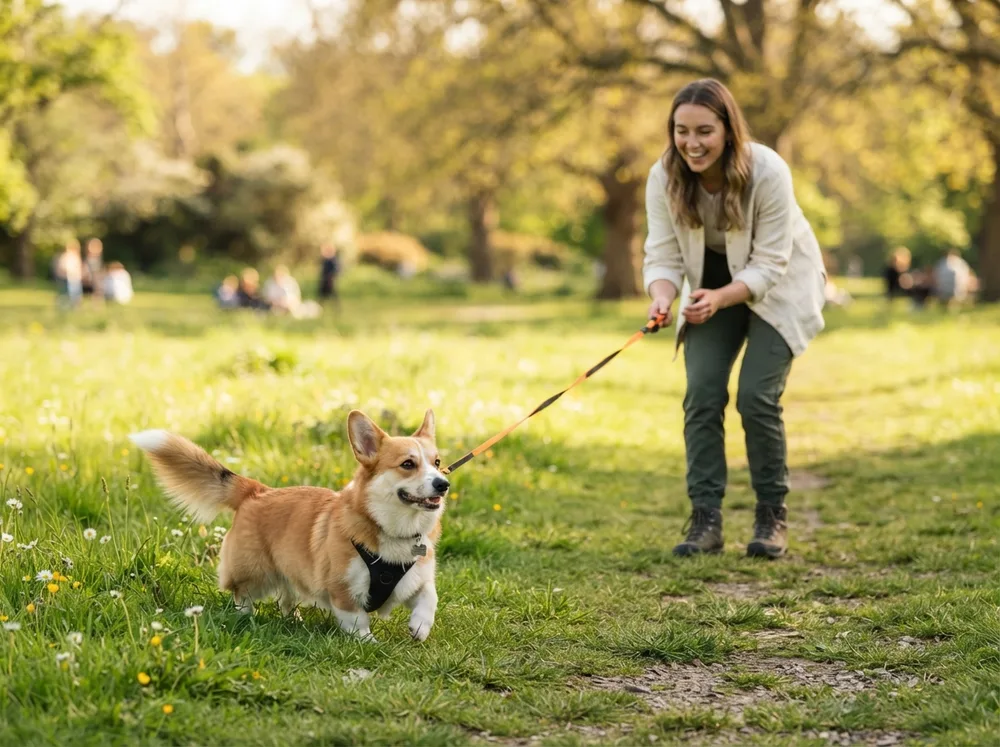
Start with a Y-harness (never a collar, the long spine forbids it), then run the deal: tight leash stops the world, loose leash moves it, paying treats at your knee. Train recall separately on a long line with a party word that never ends fun. Two to three weeks for polite walking; months for distraction-proof recall; fenced runs for freedom.
Hardware first: the Y-harness is not optional
Before any technique, the equipment ruling, because with this breed it is a spine matter: a corgi walks on a Y-shaped harness, never a neck collar. The reasoning is chassis, not fashion, a long, low back with a heavy front end concentrates every leash correction and every lunge at exactly the point the skeleton least wants loaded, and a collar delivers all of it to the front axle.
The Y-harness (chest strap forming a Y between the front legs, clip on the back) spreads force across the ribcage, leaves the shoulders free, and converts even a determined herding lunge into a body-wide nudge. The collar's remaining job is jewellery: licence tag and identification.
Skip chest-clip "no-pull" harnesses that pin the shoulders, skip head halters unless a trainer fits one for a specific problem, and skip retractable leashes entirely, they teach that pulling extends the world, reward the exact habit you are untraining, and their thin cords have no place near ankle-height children at the park.
The rest of the kit is modest: a fixed 1.5-to-2-metre leash for streets, a 5-to-10-metre long line for recall work, and a treat pouch loaded with something embarrassingly good, outdoor Singapore competes hard for a herder's attention, and kibble does not outbid a passing jogger. Cheese cubes and freeze-dried liver do.
The walking kit
- Y-harness: spreads load off the spine
- Collar: tags only, never the leash point
- Fixed 1.5–2m leash for streets
- 5–10m long line for recall training
- High-value treats, not kibble
- No retractables, ever
Loose-leash walking with a dog that has formation opinions
A corgi pulls for a herder's reason: the formation is wrong. You are drifting behind, the jogger ahead is escaping, the pigeon cluster requires management, and a dog bred to position livestock has strong views about positioning you. The cure is the oldest deal in dog training, executed with herding-grade consistency: a tight leash stops the world, a loose leash moves it.
The moment the leash tightens, you stop, mid-stride, boring as architecture; the moment it slackens (wait for it, it comes), you move, brightly, with a "let's go". No yanking, no reeling in, no commentary. To a working brain the pattern decodes in days: pulling breaks the walk, slack drives it, and since driving things is the whole point of being a corgi, slack wins.
Accelerate it with two additions. Pay the position: every few steps that the dog holds loosely near your left knee, a treat arrives at that knee, unannounced; you are salarying the formation you want until it becomes the dog's own idea. And train the gradient: corridor first, void deck next, quiet street, park connector, then the Saturday chaos, each environment only after the previous one is boring.
The classic mistake is debuting the technique at East Coast Park on a public holiday and concluding it does not work; no technique works at level ten before level two. Ten focused minutes per walk, inside the ordinary daily schedule from our exercise guide, and most corgis walk politely within two to three weeks, with one honest caveat: on the day the neighbourhood cat crosses, every dog is a first-day student again. Stop, wait for slack, resume. The system holds.
A tight leash stops the world; a loose one moves it. A herder decodes that deal faster than any breed you have met.
Recall: the honest version for a herding breed
Good news first: unlike the famously untrustworthy hunting breeds, the corgi's working history is collaborative, it evolved to check in with its human across a field, and that makes recall genuinely trainable to a high standard.
The honest caveat follows immediately: a mid-chase corgi, locked onto a cyclist, a skateboard or a fleeing playmate, is running licensed software with the volume up, and no recall on earth is 100% against instinct. The professional posture is both things at once: train recall seriously, and never bet a road on it.
The build sequence: choose a dedicated word ("here" beats the worn-out "come"), and for its first two weeks that word means one thing, a party: say it across the living room, pay three treats and thirty seconds of joy, release with "go play". Never say it to end fun, summon for baths, or scold, one "here"-then-nail-trim can bankrupt a month of deposits.
Move to the long line outdoors: quiet field, let the dog drift, call once, reel nothing, pay hugely on arrival, release again. The release is half the magic, recall that usually resumes freedom is recall a dog volunteers for. Add distance, then mild distractions, then the dog run's edges, always on the line until the dog is answering through distraction reliably, which takes months, not weekends.
And run the emergency drill monthly for life: one scatter of ten treats with a unique word ("jackpot"), so that the day a gate stands open, instinct has an answer already installed. Off-leash freedom in Singapore then lives where it legally belongs, inside fenced dog runs, with recall as your safety net rather than your fence.
Field notes for Singapore, and when to call the trainer
Local specifics that the generic guides skip. Park connectors are cyclist rivers, which to a herder are livestock on wheels: walk the dog on the side away from the cycling lane, pay heavily for calm watching, and when a peloton approaches, step off the path, cue a sit, and salary it, three weeks of that ritual converts lunging into spectating. Void decks and lift lobbies are echo chambers where a startled puppy meets rumbling trolleys and slamming doors; treat them as socialisation classrooms during quiet hours before demanding polite walking through peak traffic.
Dog runs are graduation venues, not classrooms: a corgi mid-play there will not hear a half-trained recall, so practise at the fence line first and end sessions while the dog still has listening left. And everywhere, the weather rules from our heat guide bound the schedule: training brains work worst in heat, so skill sessions live in the same cool windows the walks do.
Call in the AVS-certified trainer, your first lesson with one ships free with every puppy we place, when: pulling persists past a month of honest consistency, lunging at cyclists or joggers escalates rather than fades, the dog freezes or panics on leash (a different problem than pulling), or recall training stalls at the distraction stage.
None of these are failures; they are the normal service intervals of owning a clever working dog. The graduation photo at the end is worth the fortnights: a knee-height athlete trotting on a slack leash through Saturday crowds, checking in unprompted, recalled off a rolling tennis ball with one word, wearing the smug expression of a professional whose formation is, at last, correct.
Keep exploring
Frequently asked questions
Harness or collar for a corgi?
Y-shaped harness, always: it spreads force across the ribcage instead of loading the neck end of a long spine. The collar carries tags only, and retractable leashes are off the list entirely.
How do I stop my corgi pulling?
The tight-leash-stops, loose-leash-moves deal, executed with total consistency, plus treats paid at your knee for correct position. Train up an environment gradient; expect polite walking in two to three weeks.
Why does my corgi lunge at joggers and cyclists?
They read as escaping livestock. Distance, a cued sit, and heavy pay for calm spectating converts the response over about three weeks; escalation past that is a trainer conversation.
Can corgis be trusted off-leash?
Corgi recall trains to a genuinely high standard, the breed is collaborative, but no recall beats mid-chase instinct with certainty. Train on a long line for months, use fenced dog runs for freedom, and never bet a road.
How do I train recall?
A dedicated word that always means a party and never ends fun, built from living room to long line to distractions over months. Pay hugely, release back to freedom, and drill a "jackpot" emergency scatter monthly for life.
When can leash training start?
Week one at home: harness worn during dinner, leash dragging in the corridor, first street steps after vaccination clearance. Our free AVS-certified first lesson covers exactly this window.
Is pulling actually harmful for corgis?
On a collar, yes: leash force loads the front of a long, disc-disease-prone spine. On a Y-harness the force spreads safely, which is why the hardware section comes before any technique.
Meet your Corgi
Come say hello at Balestier
2 Balestier Road #01-701, Singapore 320002 · Weekdays 12pm–6pm · Weekends 10am–6pm. Or message us first: tell us about your home and routine, and we'll tell you honestly if a Corgi fits.
Still deciding?
Read the price guide first: every dollar explained, no surprises at the shop.
See the price guide