The tail truth
The corgi tail question, answered with a full brush
Born with tails, edited by habit: the docking history, the bobtail gene, and the natural fox brush every one of our puppies keeps.
Nelson and Kim, Curious Tails · AVS licence AS24J00046
Do corgis have tails?
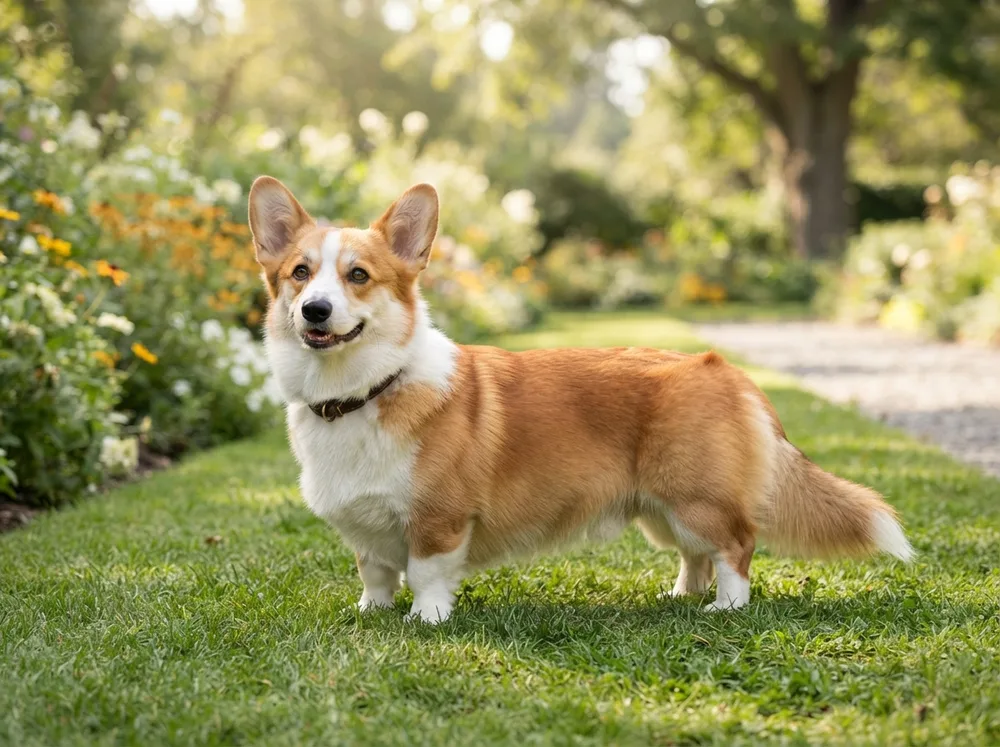
Yes. Every corgi is born with tail genetics: the Cardigan always carries a full tail, and the Pembroke grows the same fox brush unless docked, with a genuine natural bobtail gene in some lines adding confusion. The tail-less internet corgi is a docking convention, not biology. Every puppy we place keeps its natural tail, at no premium.
Do corgis have tails? Yes, and the internet owes them an apology
Every Corgi is born with a tail, or at least with the genetics for one. The bare-bottomed silhouette the internet treats as standard-issue is mostly human editing: for generations, Pembroke Welsh Corgi tails were docked, removed in the first days of life, by working convention and then by show-ring habit.
Add a genuine wrinkle, a natural bobtail gene that leaves some Pembroke lines with a short tail from birth, and you get today's confusion, where "do corgis have tails" out-searches most questions about the breed.
The full picture in three sentences. The Cardigan Welsh Corgi always has a tail, long, low-set, a proper fox brush, no exceptions. The Pembroke historically appeared docked or naturally bobbed, but grows exactly that same fox brush whenever nobody intervenes.
And the tailed Pembroke is no longer a rarity: as docking has fallen from favour across much of the world, undocked Pembrokes with full, glorious tails are increasingly what you meet at the park, including, every single time, the ones from our shop.
The tail file
- All corgis are born with tail genetics
- Cardigan: always a full, long tail
- Pembroke: historically docked or bobtail
- Natural bobtail: a real gene in some lines
- Undocked Pembroke: full fox-brush tail
- Our stock: natural tails, every puppy
Why the tails vanished in the first place
The docking convention has working-dog roots and a tax-legend garnish. The practical story: heelers, dogs that drive cattle by nipping at feet, were thought safer without a tail for a hoof to catch, and docked working dogs were the norm across many droving breeds.
The folk story: old British tax rules taxed companion dogs but not working dogs, and a docked tail marked the corgi as a worker, exempt and employed. Whatever the true mix, the show ring inherited the look, wrote it into the breed standard, and the bare bottom became "what a corgi looks like" for a century.
The modern turn is welfare-driven. Docking removes a complex, living structure from a days-old puppy for cosmetic continuity, and much of the veterinary world has moved against it: many countries now restrict or prohibit cosmetic docking outright, kennel clubs in those countries show tailed Pembrokes routinely, and the breed has not collapsed, it has simply regrown its punctuation.
We deliberately make no claims on this page about the precise regulatory position in Singapore, because we would rather say "ask your vet" than paraphrase a rule; what we can state flatly is our own policy, in the next section.
The bare-bottomed corgi is a century of habit, not a breed trait. Leave the tail alone and you get a fox brush.
Our policy: every puppy keeps its tail
Simple and absolute: every Pembroke we place carries its natural tail. Red and white, tricolour, standard coat or fluffy, no exceptions and no docked stock, and no, we cannot arrange docking on request, because we would not.
This is partly an ethics position, cosmetic amputation on a newborn buys the buyer nothing the dog would trade a tail for, and partly, honestly, an aesthetic one: a Pembroke at full stride with a flag of a tail behind it is a strictly better corgi, and we are prepared to argue the point with photographs.
The tail you get is worth the wait it took the world to allow it. A natural Pembroke tail grows into a medium-length, well-furred fox brush, carried low at rest, level or gaily up in motion, and it works for a living: tails are a dog's broadcast tower, streaming confidence, worry, invitation and joy to every dog and human in range.
Docked dogs communicate too, but with a smaller antenna; behaviourists have long noted that other dogs read shortened tails less fluently. There is a balance function besides, the tail counterweights the sprint-and-turn work this chassis loves.
None of this requires special care: the tail grooms with the rest of the coat, sheds with the rest of the coat (of course it does), and asks only that you never yank it, never let children treat it as a handle, and keep the britches beneath it mat-free on fluffies.
Buying tips, tails edition
- Ask any seller directly: docked, bobtail or natural stock?
- A "born without a tail" claim is sometimes true (bobtail gene), sometimes a docking euphemism: ask which
- Undocked should never cost extra: it is the absence of a procedure
- Cardigan adverts without tails are a breed-identity red flag
Bobtails, stumps and spotting the difference
The natural bobtail deserves its own honest paragraph, because it muddies every corgi-tail conversation. A dominant gene carried in some Pembroke lines produces puppies genuinely born with shortened tails, anywhere from a stub to a half-length brush, and historically breeders in docking-restricted countries selected for it to keep the traditional look lawfully.
A bobtail Pembroke is a normal, healthy dog, and "born like that" can be the plain truth. The practical buyer question is simply which story you are being told: a seller should know, and say readily, whether a short-tailed puppy is a bobtail line or a docked one. Hesitation on that question tells you something useful.
Visually, a docked tail is typically a very short, uniform stump finished in the first days of life; natural bobtails vary charmingly, litter to litter and puppy to puppy.
With our stock the question never arises, full natural tails across the board, but we field it weekly about other sellers' adverts, and the honest advice is the same every time: the tail story is a small window into the whole operation. Sellers who answer it plainly tend to answer everything plainly. Sellers who blur it tend to blur more than tails.
The tailed corgi is the corgi
A closing reframe for anyone who arrived here worried that a tail makes a corgi less authentic: it is precisely the reverse. The tail was always in the blueprint; the blank space was the edit. Choose a tailed Pembroke and you get the breed as biology drew it, a herding athlete with its full communication kit and its counterweight restored, plus a wag you can read from across the park.
Our available puppies all come exactly this way, photographs of current tails cheerfully supplied on WhatsApp, and if your mental image of the breed needs updating, we recommend one evening at a Singapore corgi meetup, where the tailed contingent grows every year and the wagging is, in every sense, unabridged.
Keep exploring
Frequently asked questions
Do corgis have tails?
Yes. Cardigans always have long tails; Pembrokes are born with tails too (or a natural bobtail in some lines), and the tail-less look comes mostly from historical docking. Undocked Pembrokes grow a full fox-brush tail.
Why do most corgi photos show no tail?
A century of docking convention, working-dog tradition inherited by the show ring. As docking falls from favour worldwide, tailed Pembrokes are increasingly common, including all of ours.
Do your puppies have tails?
Every single one. We stock undocked, natural-tailed Pembrokes only, and cannot arrange docking on request. Undocked never costs extra with us.
What is a natural bobtail?
A gene in some Pembroke lines producing puppies genuinely born with shortened tails. It is healthy and real, and distinct from docking; a good seller will tell you plainly which applies to a short-tailed puppy.
Is docking legal in Singapore?
We deliberately make no regulatory claims here; ask a Singapore vet for the current position. Our own answer is simpler: we do not sell docked puppies regardless.
Does a tail change corgi care?
Barely. It grooms and sheds with the rest of the coat; keep the britches mat-free on fluffies, and teach children the tail is not a handle. The communication and balance benefits come free.
Are tailed corgis worth more?
They should not cost more, an undocked tail is the absence of a procedure. Treat any "natural tail premium" as pricing theatre, the same category as rare-colour surcharges.
Meet your Corgi
Come say hello at Balestier
2 Balestier Road #01-701, Singapore 320002 · Weekdays 12pm–6pm · Weekends 10am–6pm. Or message us first: tell us about your home and routine, and we'll tell you honestly if a Corgi fits.
Still deciding?
Read the price guide first: every dollar explained, no surprises at the shop.
See the price guide