Know your corgis
Pembroke vs Cardigan: two breeds wearing one nickname
Separate histories, different tails and ears, one extra colour with a health shadow, and a Singapore market that has quietly chosen a side.
Nelson and Kim, Curious Tails · AVS licence AS24J00046
What is the difference between a Pembroke and a Cardigan corgi?
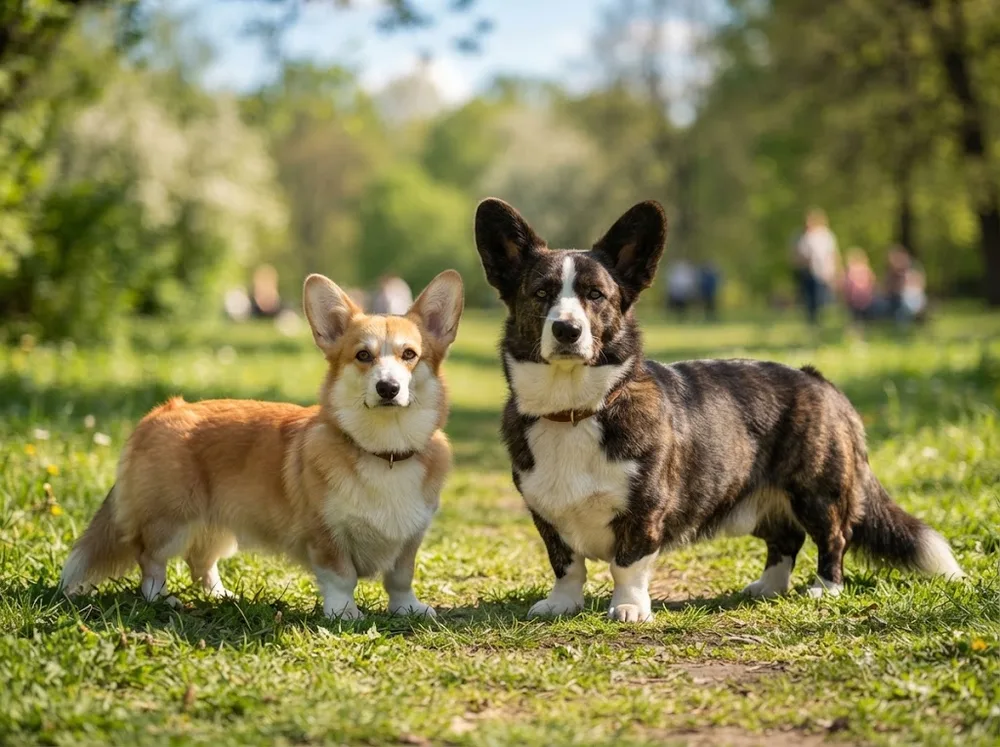
They are two separate breeds. The Cardigan is older, heavier (up to ~17kg), always has a long tail, rounder ears, and comes in brindle and blue merle. The Pembroke is lighter (~10–13kg), fox-faced, historically docked, and is the breed Singapore actually sells. Neither is HDB-approved.
Two breeds, not two flavours
The most useful thing this page can tell you arrives in the first sentence: the Pembroke Welsh Corgi and the Cardigan Welsh Corgi are two separate breeds, recognised separately by every major kennel club, with different histories, different builds and different registries. They are not a size split like Poodles or a coat split like Dachshunds.
The Cardigan is the older breed by centuries, an all-round farm dog from the rocky hill country of Cardiganshire in Wales; the Pembroke rose in neighbouring Pembrokeshire, tradition says with Flemish weaver influence, and became the cattle-heeling specialist the world now knows from palace photographs.
They were shown as one breed until the 1930s, when the clubs separated them for good, and a century of separate breeding has kept them cousins rather than twins.
Why does this matter to a Singapore buyer? Because the internet mixes the two freely, most "corgi facts" articles describe a blend of both, and buyers arrive asking for "the corgi with the tail" or "the merle corgi" without knowing they have crossed a breed boundary. This page untangles it, and then tells you what the local market actually stocks.
Fastest tell-apart guide
- Tail: Cardigan always full; Pembroke historically docked or bobtail
- Ears: Cardigan larger, rounder; Pembroke pointed, foxier
- Bone: Cardigan heavier, front slightly turned out
- Colours: Cardigan adds brindle and blue merle
- Weight: Cardigan up to ~17kg; Pembroke ~10–13kg
- Both: herding brains, big barks, serious shedding
Side by side, honestly scored
Averages, not certainties; individual dogs wander happily off these charts.
| Trait | Pembroke Welsh Corgi | Cardigan Welsh Corgi |
|---|---|---|
| Origin | Pembrokeshire, Wales | Cardiganshire, Wales (older breed) |
| Build | 10–13kg, lighter bone, level topline | 11–17kg, heavier bone, curved front |
| Tail | Historically docked; natural bobtail lines exist; ours keep full natural tails | Always a long, low-set fox brush |
| Ears | Pointed, fox-like | Larger, rounded tips |
| Colours | Red, sable, fawn, tricolour (with white) | All those plus brindle and blue merle |
| Temperament tilt | Brighter-voiced, busier, more socially forward | A notch steadier and more reserved with strangers |
| Lifespan | About 12 to 13 years | About 12 to 15 years |
| HDB status | Not approved | Not approved |
The tail question, since it built this rivalry
"Which corgi has the tail?" is the single most-asked version of this comparison, and the honest answer has layers. The Cardigan always has one, a long, low fox brush, non-negotiable, part of the breed. The Pembroke's bare look is mostly human-made: historical docking convention, plus genuine natural-bobtail lines where puppies are born with short tails.
Docking is restricted or vet-gated in a growing list of countries, attitudes have shifted, and undocked Pembrokes with full brushes are increasingly common and, we would argue, increasingly preferred. Our own stock policy removes the question entirely: every Pembroke we place keeps its natural tail. If you meet a tailed corgi in a Singapore park, you are most likely looking at an undocked Pembroke, not a Cardigan.
A tailed corgi in Singapore is almost always an undocked Pembroke. Cardigans here are genuinely rare.
Merle: the Cardigan-only colour and its shadow
Blue merle, that marbled grey-and-black coat with occasional blue eyes, exists in the Cardigan and does not naturally exist in the Pembroke. Two consequences matter. First, a "merle Pembroke" advertised anywhere is a red flag: the gene had to come from outside the breed, which means crossbreeding somewhere recent, whatever the paperwork claims.
Second, merle itself demands responsible pairing, because breeding merle to merle produces "double merle" puppies with a well-documented risk of congenital deafness and serious eye defects. Ethical Cardigan breeders never pair two merles; volume sellers chasing a striking coat sometimes do.
Our shop's line is simpler still: we place Pembrokes only and we never place merle of any kind, so the trap has no door here. If you pursue a Cardigan abroad, ask the breeder directly how they pair merles, and walk away from any hesitation.
Merle rules of thumb
- Merle "Pembroke" = crossbreeding signal, decline it
- Merle x merle breeding = double-merle risk: deafness, eye defects
- One merle parent maximum is the ethical standard
- A striking coat is never worth a deaf puppy
What Singapore actually sells, and what we place
The SG market is, in practice, a Pembroke market. Licensed shops and import channels here deal overwhelmingly in Pembrokes; the Cardigan is a genuine rarity that usually means a specialist import with a long lead time.
That is why our shop places Pembroke Welsh Corgis only: red and white, tricolour and fluffy coats, natural tails, no merle, $3,288–$4,488 all-in. We would rather do one breed properly, with a real pipeline and real aftercare, than list a breed we cannot reliably source.
And the fact that outranks the whole comparison for many readers: neither breed is HDB-approved. Pembroke or Cardigan, docked or tailed, brindle or red, no corgi may legally live in an HDB flat, and we qualify housing before price with every buyer.
If your heart says Cardigan and your address says private housing, we are happy to talk honestly about what an import would involve, including why we may point you to a specialist rather than pretend to stock one.
Temperament-wise, treat the differences as seasoning rather than substance. Both breeds carry the full herding package: quick brains, big voices, ankle-management instincts and a genuine daily exercise requirement. The Pembroke tends to run a notch busier and more socially forward, the Cardigan a notch steadier and more watchful with strangers, and both turn destructive when bored in exactly the same creative ways.
Families choosing between them on personality alone are usually choosing between individual puppies, not breeds; the litter in front of you matters far more than the club register behind it. Which is one more reason the practical Singapore answer is the Pembroke: you can actually meet the litter, watch the bold one herd its siblings, and choose a temperament with your own eyes rather than importing a description.
Keep exploring
Frequently asked questions
Which breed of corgi is calmer?
The Cardigan, generally. Cardigans tend to be steadier and more reserved with strangers, while Pembrokes are the more outgoing, attention-seeking of the two. Both are herding dogs with real energy, so "calmer" is relative: neither is a low-energy breed, and a Cardigan still needs the same daily walks and mental work as a Pembroke.
Which is more expensive, a Pembroke or a Cardigan?
In Singapore the question is mostly academic, because Cardigans are rarely available here at all. The Pembroke is the market default and effectively the only Corgi placed locally, ours included. Where both are available overseas, prices sit in a similar band and are driven by the breeder rather than by which of the two breeds it is.
What is the rarest type of Corgi?
Among Pembrokes, sable is the least common of the standard colours, and the long-coated "fluffy" is an uncommon variant. Rarity is not a quality signal and we charge no premium for it. Merle is a separate matter: it does not occur naturally in the Pembroke, so a merle "Pembroke" indicates crossbreeding, and we never place merle Corgis.
Are Pembroke and Cardigan corgis the same breed?
No. They are two separate breeds with different origins, recognised separately since the 1930s. The Cardigan is older, heavier-boned, always tailed, and comes in brindle and merle; the Pembroke is the lighter, foxier breed the internet knows.
Which corgi has a tail?
The Cardigan always does. Pembrokes historically had docked tails, though natural bobtail lines exist and undocked Pembrokes keep a full brush. Every Pembroke we place keeps its natural tail.
Which corgi is in Singapore shops?
Almost exclusively the Pembroke. Cardigans are rare specialist imports here. We place Pembrokes only: red and white, tricolour and fluffy, all natural-tailed.
Is either corgi HDB approved?
No. Neither the Pembroke nor the Cardigan appears on the HDB approved list (verified July 2026). Both are private-housing breeds in Singapore.
Which corgi is bigger?
The Cardigan, at roughly 11 to 17kg with heavier bone, versus the Pembroke at about 10 to 13kg. In person the Cardigan reads noticeably more substantial.
What is wrong with merle corgis?
Merle only belongs in the Cardigan; in a Pembroke it signals crossbreeding. Merle-to-merle pairings risk double-merle puppies with congenital deafness and eye defects, which is why we never place merle of any kind.
Which breed suits a first-time owner?
Either, honestly, if the household is active; both are smart, loud and shedding-heavy. The Pembroke is easier to actually find in Singapore, which usually settles it.
Meet your Corgi
Come say hello at Balestier
2 Balestier Road #01-701, Singapore 320002 · Weekdays 12pm–6pm · Weekends 10am–6pm. Or message us first: tell us about your home and routine, and we'll tell you honestly if a Corgi fits.
Still deciding?
Read the price guide first: every dollar explained, no surprises at the shop.
See the price guide